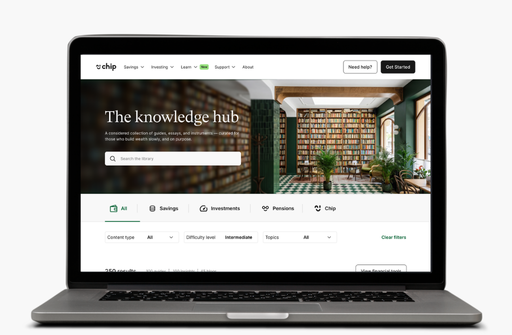
The knowledge hub

A considered collection of guides, essays, and instruments — curated for those who build wealth slowly, and on purpose.

0
results
Filter results
Filter by:
Content type
Difficulty level
Topics
0
results
View financial tools
5 Easy Ways To Help Save Money
2 min read
Beginner
Savings Strategies & Tips

There are many simple and effective ways to cut down on your spending, so you can save more money each month. 

If you're looking for some inspiration on how to save money in the UK, here are five great tips to help you get started. See how long it will take to reach your savings goal with our savings calculator.

1) Make a budget and stick to it

The first and most important step to saving money is to have a budget. A budget is simply a plan for your money, which helps you see exactly where your money is going.

Make a list of all your income and expenses, and see where you can cut down. 

Once you have a savings budget, make sure you stick to it. This is the key to saving money and keeping your finances under control. Learn about different savings accounts.

This is not financial advice - this is about simple tips to get going, while not impacting your day to day life or living a life of extreme frugality.

So if this sounds like it’s for you, read on!The following should not be taken as advice or guidance around financial hardship. If you're in this situation, there is support available from GOV.UK or Citizens Advice that can help.

2) Cut down on your food expenses

Food is one of the biggest expenses in many households. By being smart about your food shopping, you can save a lot of money. 

For example, buy food in bulk when it is on sale, and freeze it for later. Consider swapping big brands for own brand products or using discount supermarkets.

Cook meals at home instead of eating out, and bring your lunch to work instead of buying it. These small changes can add up to big savings.

3) Reduce your energy bills

Another way to save money is by reducing your energy bills. You can do this by washing your clothes at 30 degrees, using energy-efficient light bulbs, and turning off appliances when they're not in use.

Heating is a big expense so turning down radiators and the flow temperature of your boiler to 60 degrees can also help you make big savings over the year. 

There are plenty of resources online such as GOV.UK with tips.

4) Shop around for the best deals

When it comes to buying things like insurance, broadband, and mobile phone contracts, it's important to shop around for the best deals. 

Don't just go with the first offer you see, take the time to compare prices and find the best deal for you. You can use price comparison websites to make this easier.

5) Save a little each month

Finally, one of the easiest ways to save money is by setting aside a little each month. You don't have to save a lot, just a few pounds here and there.

Start by setting up a regular amount (on payday for example) to go from your bank account to a savings account and watch your savings grow over time.

Saving money is all about being smart with your finances. By following these five money-saving tips, you'll be able to cut down on your spending and keep more money in your pocket. So, why not get started today?

ISAs Explained
2 min read
Beginner
Accounts & Products

What is an ISA?‍

ISA stands for Individual Savings Account, it’s a tax-efficient account, also known as a ‘tax wrapper’ for a savings or investments account. This means you don’t pay tax on any returns you earn on money held in an ISA. They present a hugely popular way to save and invest in the UK.

There are four kinds of ISAs (more on this later) available and at Chip we offer access to a Cash ISA and a Stocks & Shares ISA - where you pay no tax on your savings interest or UK income or capital gains on returns (or profit) from your investments.

As of April 2024, you can open multiple of the same type of ISA in the same tax year, as long as you stay within your £20,000 ISA allowance.

You can read more about ISAs on the official UK Government website here.

Who can open an ISA? 

To open an ISA you need to meet the following criteria 

  • You’re over 18
  • You’re a UK tax resident
  • You aren’t a US citizen

How do ISAs work?

ISAs function in much the same way as a regular bank or savings accounts with the key difference being you can only put a limited amount of money into an ISA every tax year, this is known as your annual ISA allowance.

What’s my ISA allowance?

All UK residents over 18 currently have an annual ISA allowance of £20,000 per tax year. The tax year runs from 6 April to 5 April the following year. Any unused allowance doesn't roll over into the following tax year. 

For example, if you don’t use your full £20,000 this year (2024/25), and only put in £15,000, you can’t carry the remaining £5,000 over to the next tax year and invest £25,000 into an ISA.

As of the new tax year (2024/25) paying into multiple of the same type of ISA in a single tax year is now allowed.

What are the benefits of an ISA?‍

  • The main benefit of an ISA is that any returns you earn are tax-free. This means you don't need to pay any income tax, capital gains tax, or dividend tax on returns or interest you earn.
  • Some ISAs (including Cash ISAs and Stocks & Shares ISAs) can be flexible, meaning you can withdraw and replace cash in the same tax year without it affecting your annual allowance. Not all providers offer this service however, so it’s best to check. Chip’s Stocks & Shares ISA is flexible. 
  • You’ll often see the figure of £20,000 in relation to ISAs but this is just the maximum amount you can pay in. You don’t need to have this much available to get started and you can start seeing the benefits of an ISA from as little as £1. 
  • You can transfer your ISAs from one provider to another at any time and even transfer between different types of ISAs. If you want to transfer to your Chip ISA from a provider outside of Chip, you must transfer all of it. Unfortunately, we are unable to offer partial transfers at this time.

What types of ISA are there?

There are 4 types of ISA available in the UK. These are Cash ISAs, Stocks and Shares ISAs, Innovative Finance ISAs and Lifetime ISAs.

How many ISAs can I have?

You can hold as many of them as you like but note that your £20,000 ISA allowance covers all of them (not £20,000 per ISA) in a single tax year.

Which ISA might be right for you?

The type of ISA you want depends on your circumstances. A cash ISA may suit you best if you’re looking for easy access to your money and you think you might go over your personal savings allowance in a tax year.

However, it is worth considering that easy-access savings accounts without an ISA wrapper typically offer better interest rates.

If you’re taking a longer term view and are prepared to take on some risk, you can seek potentially higher returns with a Stocks and Shares ISA or an Innovative Finance ISA.

If you’re looking towards buying your first home or retirement then a Lifetime ISA could be the right fit. 

The state pension
2 min read
Beginner
Pension basics

What is the State Pension? 

The State Pension is a regular payment you receive from the government during retirement, funded by your National Insurance contributions during your working years. 

There are currently two systems in operation, depending on your age:

  • The “new” State Pension: For men born on or after 6 April 1951 and women born on or after 6 April 1953.
  • The “basic” State Pension: For anyone born before those dates.

What is the State Pension age? 

The State Pension age is the earliest age you can start receiving your payments. This is set by the government and is subject to change.

  • Currently the State Pension age is 66 for both men and women.
  • Future changes have been legislated for a rise to 67 between 2026 and 2028.

How much is the State Pension? 

The amount you’ll receive is based on which system you fall under and your National Insurance. These rates apply to the 2025/2026 tax year. 

  • The full rate for the new State Pension is £241.30 a week (approx. £12,547 a year)
  • The full rate for the basic State Pension is £184.90 a week (approx. £9,615 a year)
For couples 

A common question is whether a joint amount is paid out to couples. The State Pension is based on your individual National Insurance record, meaning you and your partner will claim separate amounts. If you both qualified for the full State Pension, you’d receive an income of approximately £25,095.

For a widow 

If your spouse or civil partner passes away, you may be able to inherit some of their State Pension, but the rules around this are complex. 

  • Under the old system (reached pension age before 2016) you can often inherit a significant portion of your partner's ‘Additional State Pension’ (SERPS).
  • Under the new system (reached pension on or after 6 April 2016) it is much harder to inherit. Typically, you can’t inherit their main pension, but you may inherit a ‘protected payment’ if they built up a very large pot under the old rules. 

How much State Pension will I get? 

The amount you receive is not a fixed salary, it is a payment calculated from your ‘qualifying years’ of National Insurance (NI) contributions.

A qualifying year is one in which you were working and made NI contributions, received NI credits (e.g. you were ill, unemployed or a carer), or made voluntary NI contributions. 

  • To qualify for the full amount you generally need 35 qualifying years.
  • To qualify for any amount you need at least 10 qualifying years.
  • To qualify for a proportional amount you’ll need between 10 and 35 qualifying years (e.g. 18 years would qualify you for half the full amount). 

How do I check my State Pension forecast?

If you want to check how much State Pension you might qualify for, you can do this online.

Check your State Pension forecast using the free tool on the government website.

When do I get my State Pension?  

You can claim your State Pension up to four months before you reach your qualifying age. This is then paid directly into your bank account every four weeks . 

The State Pension is taxable income, however, this is not deducted from the payment directly; it makes up part of your Personal Allowance.

Any due tax is usually taken from your other income sources like a private pension or salary. 

What is the full State Pension?

The ‘full State Pension’ refers to the maximum standard rate (£241.30 per week for the new State Pension).

However, it is possible to receive more than this if you have deferred (delayed) taking your pension, or if you have ‘Protected Rights’ from the old system. 

‘Protected Rights’ refers to a protection of claimants of the old ‘additional’ State Pension, who were entitled to receive more than the new full State Pension. 

What is Pension Credit? 

Pension Credit is a separate, tax-free benefit for people over State Pension age who are on a low income.

It is distinct from the State Pension because it is means-tested; based on your income and savings, not your National Insurance record. 

It is often called a 'gateway benefit' because claiming it can unlock other support, such as free TV licences (for over-75s) and Council Tax reductions.

The Winter Fuel Payment is now available to pensioners with an income up to £35,000, but Pension Credit remains the most reliable route to ensure you receive it if you are on a low income. 

How much is Pension Credit a week? 

For the 2026/27 tax year, Pension Credit tops up your weekly income to a guaranteed minimum level:

  • For single people this is £238.00 per week.
  • For couples tops up joint income to £363.25  per week.

If you have a disability or caring responsibilities, you may be entitled to extra amounts on top of this.

Who is eligible for Pension Credit? 

You must live in England, Scotland, or Wales and have reached State Pension age.

  • Income rule: Your weekly income generally needs to be below the thresholds listed above.
  • Savings rule: If you have savings over £10,000, your entitlement is reduced. For every £500 you have over £10,000, it counts as £1 of weekly income. 
How to apply for Pension Credit? 

You can apply online via the GOV.UK website, by post, or by phone. You will need your National Insurance number, details of your income/savings, and your bank account information. 

  • Pension Credit Claim line: 0800 99 1234

Workplace pensions

While the State Pension provides a guaranteed safety net, £12,500  a year is likely far too little for a comfortable retirement.

Creating the lifestyle you dream of after you stop working may require a second stream of income. 

For most people, this comes from their workplace pension, which is arguably the most powerful savings tool available to UK employees. When you pay in, your employer has to pay in too.

Read our next guide and get a better understanding of workplace pensions.

Markets respond to conflict in the Middle East: what it means for you
2 min read
Beginner
Investing strategies

We’re going to take a moment to comment on how events in the Middle East have impacted financial markets. This is a constantly evolving situation, so what you read here reflects the situation as of 12:00 GMT 13 March 2026. 

Before we start: What this could mean for your day-to-day 

Here’s a quick summary of the headlines that outline some of the knock-on effects of what a prolonged conflict might mean. 

The fuel & bills effect: Regional tension spikes oil prices, which is important, as it's a direct link to higher costs at the petrol pump and potentially stickier energy bills at home. (This Is Money)

Shopping basket surcharge: Rerouting ships to avoid hotspots adds weeks to journeys and millions to freight costs. This eventually makes everything from electronics to your weekly food shop more expensive. (Retail Gazette)

Mortgage & interest rate link: If costs stay high, inflation becomes harder to "kill off." This makes the Bank of England less likely to cut interest rates, meaning those cheaper mortgage deals could stay out of reach for longer. (BBC)

When conflict erupts, and geopolitical events intensify, the reaction can be swift. Institutional investors try to assess potential impacts on global trade, energy prices, and broader economic stability. That uncertainty can lead to short-term volatility.

Energy markets tend to be particularly sensitive to developments in the region because of the Middle East’s importance to global oil supply.1 Even the possibility of disruption can influence prices and investor sentiment, and because energy affects all walks of life, the reaction is global.

As a result, stock markets have seen fluctuations over the last 12 days, reflecting a familiar pattern: geopolitical news triggering short bursts of market movement.

Why markets often react this way

Financial markets are forward-looking and like certainty. When unforeseen events occur, whether it’s conflicts, elections, or diplomatic developments, this can make the economic outlook suddenly unpredictable.

In the short term, this presents itself as volatility in our investments.

But historically, markets tend to process these events relatively quickly. Once the immediate uncertainty fades or events become clearer, investors usually shift their attention back to economic fundamentals like corporate earnings, growth forecasts, and central bank policy.2

Volatility is part of the investing journey

While it can feel unsettling, volatility is a completely normal part of investing.

Even in strong market years, markets regularly experience temporary dips or fluctuations. These moments often reflect the market adjusting to new information, such as shifting interest rate forecasts, unexpected corporate earnings reports, or sudden geopolitical developments like we’ve seen this week.

Importantly, many geopolitical shocks in the past have caused short-term market reactions but had limited long-term impact on global equities.3

For long-term investors, these periods are simply part of the journey.

Keeping perspective as an investor

When headlines dominate the news cycle, it can be tempting to react quickly. But long-term investing usually benefits from staying focused on the bigger picture.

Market history shows that reacting to short-term volatility can sometimes do more harm than good. Instead, many investors focus on maintaining a diversified portfolio and continuing to invest consistently over time.4

This approach helps smooth out the ups and downs that naturally occur in markets.

Final thought

While global events can influence markets in the short term, long-term investing is about staying committed to your goals, through both calm and uncertainty.

Ultimately, your portfolio should be centred on the future, not the news cycle. By staying consistent and zooming out, you’re ensuring that when the dust settles, your long-term financial plan is still on track.

Sources:

1International Energy Agency (IEA) 2Vanguard 3J.P. Morgan 4Fidelity

What is diversification?
2 min read
Beginner
Portfolio building

Understanding the importance of diversification

Markets can move unpredictably. One asset class might be soaring while another is falling. Diversification ensures you’re not overly reliant on a single investment or sector to meet your financial goals.

For example, if your portfolio is made up entirely of tech stocks, a downturn in the tech industry could cause a sharp drop in your portfolio. But if you also own bonds, commodities, and shares in other industries, those assets may hold steady or even rise, helping cushion the blow.

Diversification doesn’t guarantee profits, but it can make the investing journey less bumpy by balancing the ups and downs.

Diversification strategies in investing

There are many ways to diversify a portfolio. Investors often combine several of the following approaches:

  • Asset classes: such as stocks, bonds, real estate, commodities, or cash equivalents.
  • Industries and sectors: spreading across technology, healthcare, finance, consumer goods, and more.
  • Market capitalisations: investing in both large, stable companies (blue chips) and smaller, growth-focused firms.
  • Risk profiles: mixing higher-risk, higher-return assets with safer, lower-yield options.
  • Tangibility: balancing between traditional financial assets and physical assets like property or gold.

The right mix depends on your goals, time horizon, and risk tolerance.

Advantages of diversification

  • Could reduce the risk of heavy losses from one sector.
  • Could provide protection against market fluctuations.
  • Could help investors achieve steadier long-term growth. 
  • Offers exposure to different markets and opportunities. 

Disadvantages of diversification
  • Can limit short-term gains if one area performs very well.
  • More complex and time-consuming to manage.
  • May involve higher costs or fees, especially if spread out across platforms. 
  • Can feel overwhelming for new investors looking for a simpler approach. 

How to assess portfolio diversification

Holding several different investments doesn’t guarantee your portfolio is diverse, the weighting of each investment matters too.

For example, holding ten different stocks might look diverse, but if they’re all in the same industry, you’re still exposed to the same risks.

One way to assess diversification is by looking at how much of your portfolio is concentrated in one asset class, sector, or company. Tools and portfolio trackers can help you see where your money is spread and identify any gaps or imbalances.

See our full guide on portfolio management.

Diversification summary

Diversification is one of the simplest yet most effective ways to manage risk in investing. By spreading your money across different asset types, industries, and markets, you can give yourself a smoother journey towards your long-term goals.

Next in this series: How to rebalance your portfolio, why it matters and how to adjust your investments to stay on track.

The FSCS limit for savings is changing to £120,000
2 min read
Accounts & Products

From 1 December 2025, the Financial Services Compensation Scheme (FSCS) guarantee limit for savings is increasing from £85,000 to £120,000 per person, per bank.

The FSCS guarantee for investments is not changing and is remaining at £85,000.

You do not need to do anything to benefit from this change, it will be applied automatically by the FSCS.

We will update our content and materials shortly after 1 December 2025 to reflect the new limits.

What does this mean for my money held in Chip?

The FSCS guarantee for savings is managed by the Bank of England and FSCS agency directly and they have stated the new limit will be in effect from 1 December 2025.

So, from then on, in the unlikely event that Chip, or our partners (ClearBank for savings and Seccl Custody Ltd.) should fail, you will be covered up to:

  • £120,000 of eligible deposits in your savings accounts, and;
  • £85,000 of eligible deposits in your investment accounts.

You can read more about how your money is protected at Chip here: https://getchip.uk/how-we-protect-your-money

Your savings accounts

Four of Chip’s savings accounts are provided by our partner bank, ClearBank.

This means your FSCS cover across all savings you hold in Chip is £120,000 in total across all accounts from 1 December 2025. Please note, FSCS cover applies per person, per bank, so if you hold other accounts powered by ClearBank outside of Chip, your cover will also be shared across them.

You can hold larger deposits than the FSCS protection cover amount. Chip savings accounts balance limits are currently:

  • Chip Cash ISA: unlimited, but new deposits capped at £20,000 per tax year depending on your individual circumstances and subject to change in the future
  • Instant Access Account: £1 million
  • Easy Access Account: £1 million
  • Prize Savings Account: £85,000

You can read more about how ClearBank protects your money here. Please note that the Chip Cash ISA isn't available for new customers.

For the Smart Cash ISA: Money deposited into the Smart Cash ISA is held across established UK licensed banks, such as Barclays, Lloyds and HSBC and is eligible for cover by the Financial Services Compensation Scheme (FSCS), subject to FSCS conditions.FSCS limits of £120,000 per person, per bank apply, subject to eligibility. As funds may be held across multiple UK licensed banks, protection applies separately to deposits held with each bank.

Your Chip investment accounts

The money in Chip investment accounts sits with a different firm (Seccl Custody Ltd.) than our savings accounts, so you enjoy separate FSCS cover for this money.

Your FSCS cover for investments is unchanged by this news and remains up to £85,000 of eligible deposits across all your investment accounts in Chip, so if you have both a Stocks & Shares ISA, and a General Investment Account (GIA) open, your cover is spread across both of those accounts.

As with savings, FSCS cover for investments applies per person, per institution, so if you hold investment accounts with Seccl Custody Ltd. outside of Chip, your total cover of £85,000 will also be spread across those.

You can hold more than the FSCS protection limit in Chip investment accounts. The total balance limits per account are currently:

  • Stocks & Shares ISA: unlimited, but new deposits capped at £20,000 per tax year depending on your individual circumstances and subject to change in the future
  • General Investment Account (GIA): unlimited

Remember, FSCS doesn’t cover you for investment performance, or in the event that your investments go down and you get back less than you put in.

The savings FSCS limit increase comes into effect on 1 December 2025

The new £120,000 FSCS limit comes into effect on 1 December 2025.

You don’t need to do anything to benefit from this change, it will automatically be applied by the FSCS.

The Bank of England has set financial firms a deadline of May 2026 to update all their content, marketing materials and disclaimers to reflect the new limit.

However, we aim to update all of our content across our app, website, documents and automated emails as close as possible to 1 December 2025.

The details

On midnight 18 November 2025 the Prudential Regulation Authority (PRA) from the Bank of England (BoE) announced the FSCS limit will increase from £85,000 to £120,000 from 1 December 2025.

The PRA is responsible for oversight of FSCS protection in respect of deposits for banks.

The PRA does not govern FSCS limits for investment accounts, which are determined by the FCA and there have been no announcements from the FCA about increasing the limits for investments.  

If this changes, we will also update you.

Your ISA deposit deadlines for the 2025/2026 tax year
2 min read
Rates, Tax & Economics

The 2025/26 tax year ends at midnight on 5 April 2026 and your annual ISA allowance will reset for a new tax year.

If you have any ISA allowance remaining (you can check this in your app) and want to make a deposit within the 2025/26 tax year, here’s the deadlines you need to know.

Deposit before:

  • 23:00 on Tuesday 31 March 2026 — Stocks & Shares ISA
  • 23:00 on Thursday 2 April 2026 — Smart Cash ISA  

Deposits that successfully make it into your Chip ISAs before these deadlines will count towards your 2025/2026 ISA allowance.

Any further deposits into your Cash ISA beyond these deadlines, may still successfully land in your balance, but we can’t guarantee it. Successful deposits made before 23:59 on Sunday 5 April will count towards your 2025/2026 ISA allowance.

But please note that there can be unexpected delays, often caused by banks limiting deposits out and circumstances outside of our control. Your deposit is only valid when it reaches our banking partner—see more below.  

Next year will be the last year you can use your full allowance in cash

In the 2025 Autumn budget the government announced that 2026/27 will be the last year where you put your full £20,000 annual ISA allowance into cash.

From April 2027 onwards you will only be able to put £12,000 of your total £20,000 annual allowance into cash (unless you’re over 65).

So, bear in mind if you do like to put your full allowance into cash, you’ve only got one more year to fill it up.

Best ways to deposit

Our most popular option for transferring into your ISA is through connected bank transfer. Simply follow the instructions in the app to connect to your provider.

You can also make a manual bank transfer into your Cash ISA, which is best used for making deposits over £5,000.

In most cases, for both of these methods, your money arrives in seconds, but it can take up to two hours.

Looking to transfer from another ISA?

You can easily transfer an ISA from another provider into Chip’s Cash or Stocks & Shares ISA.

Transfers don’t affect your annual £20,000 ISA allowance, as your allowance applies to new money only, so you don’t need to factor this in regard to the end of the tax year. You’re free to initiate a transfer anytime you like.

Make sure you check our list of approved Cash ISA providers we accept transfers from.

Unfortunately, we are unable to accept transfers from providers not on this list at the moment, but we are adding more all the time.

Having trouble depositing?

If this is your first ISA deposit, we’ve found our members have the most success making a first deposit of less than £1,000.

Keep in mind that your bank may limit daily transactions on transferring money from your current account to your ISA.

These limits can vary drastically between providers, so check with your bank if you’re looking to move larger amounts.

You may have also set your personal limits on daily transfers, so adjust these accordingly if you haven’t already.

There may also be additional security checks on larger transactions, so factor this in and try and plan ahead.

“I’m lost, what’s an ISA?”

ISAs are tax-efficient savings and investment accounts that offer tax-efficient exemptions on interest and returns earned within the account.

However, you are limited to depositing £20,000 within a given tax year (which runs April to April). This is your ‘annual ISA allowance’ and it is available on a use it or lose it basis.

You can learn more about ISAs in our quick guide here.

It’s simple with Chip

Navigating ISAs is easy with Chip. You can have a Cash ISA, Stocks & Shares ISA or both; all accessible in one easy-to-use app.

Our flexible Smart Cash ISA allows you to make unlimited withdrawals and deposits without affecting your £20,000 allowance. Providing penalty-free access to your funds, whenever you need them, with all the tax advantages.

Our Stocks & Shares ISA allows you to effortlessly set up recurring deposits, which are then invested directly into the funds you've selected. This ensures your money is consistently working for you in your chosen investments to build wealth tax-free.

What are gold and commodities?
2 min read
Intermediate
Asset classes

Why do people invest in gold?

Gold has held its appeal for thousands of years and for good reason. It’s often viewed as a safe haven1 (prices can fluctuate) investment that people turn to during periods of uncertainty.

Here’s why it continues to attract attention from investors:

  • Store of value: In times of economic crisis or market downturns, gold tends to retain its worth better than riskier assets.
  • Hedge against inflation: When inflation rises and currency loses purchasing power, gold has historically maintained or increased its value – acting as a financial hedge.2
  • Diversification: Gold doesn’t typically move in the same direction as stocks or bonds, making it a useful addition to a balanced portfolio.

1Investopedia

2Investopedia

How to invest in gold in the UK

There are several ways to gain exposure to gold, depending on your preferences, budget, and investment goals:

1. Physical gold
  • Pros: Tangible, recognised globally, no counterparty risk (the chance that a party to a financial transaction, like a loan, investment, or trade, will fail to fulfill its obligations, potentially leading to losses).
  • Cons: Needs safe storage, insurance, can be less liquid than other options.
2. Gold ETFs, Gold ETCs and funds
  • Pros: Simple, cost-effective, easy to buy/sell like stocks.
  • Cons: Doesn’t give you access to physical gold. May involve price tracking errors or management fees.
3. Gold mining stocks
  • Pros: Potential for higher returns if gold prices rise.
  • Cons: Company-specific and operational risks. 
4. Gold savings accounts or digital vaults
  • Pros: Fractional ownership (an option to share between a number of investors), digital ease, lower entry point.
  • Cons: May have account or withdrawal fees, and depends on provider trustworthiness.

Risks and disadvantages of investing in gold 

Like any asset, gold has its downsides. It’s important to understand these before diving in:

  • No income: Gold doesn’t pay dividends or interest – returns are confined to price growth (may be subject to Capital Gains tax).

  • Price volatility: Despite its ‘safe haven’ label, gold can still fluctuate in value based on market sentiment, interest rates, or geopolitical news.

  • Storage and insurance costs: Holding physical gold securely often comes with extra fees and responsibilities.

Historical performance of gold

Gold has historically provided moderate long-term returns, though it can go through extended periods of underperformance. Over the past 20 years, gold has returned an average of ~12% per year.1

It has historically performed best during:

  • Inflationary periods
  • Currency devaluations
  • Market shocks or crises

1 J.P. Morgan

Investing in other precious metals and commodities

Gold isn’t the only option when it comes to tangible assets. Other precious and industrial commodities can also play a role in your strategy.

Precious metals:
  • Silver – More volatile than gold, with both monetary and industrial demand.
  • Platinum & palladium – Used in manufacturing and clean energy tech, offering unique demand drivers.
Broader commodities:
  • Oil & natural gas – Linked to global energy prices. Prone to sharp swings but still essential to global economies.
  • Agricultural commodities – Wheat, coffee, sugar, and livestock can offer growth tied to global supply/demand shifts.

These can help hedge against inflation or add exposure to global growth – but also carry distinct risks based on weather, politics, or regulation.

How to invest in commodities in the UK

You don’t need to stockpile barrels of oil or coffee beans to invest in commodities. Here are some beginner-friendly ways to get started:

  • Commodity ETFs/ETCs – Track the price of specific goods or baskets of commodities (e.g., gold, oil, agriculture).
  • Futures contracts – More advanced and high risk – these involve speculating on the future price of a commodity.
  • Commodity-producing companies – Invest in miners, energy producers, or agricultural businesses.
  • Physical metals – As mentioned, physical gold or silver remains popular for tangibility and trust.

Gold and commodities in a diversified portfolio

Commodities behave differently than traditional assets like stocks and bonds – so they can add balance to your portfolio.

They’re often non-correlated, meaning they may rise when stocks fall (especially during inflation, currency shocks, or geopolitical events).

Investing in gold and commodities summary

Gold and other commodities can be powerful tools for diversification, especially in uncertain economic times.

They don’t generate income like stocks or bonds, but they can help protect against inflation, currency weakness, or financial market shocks.

The right amount for your portfolio depends on your goals, risk tolerance, and time horizon. However, even a small allocation can go a long way in building resilience.

In the next guide of the series we take a closer look at cryptocurrencies and how they work. 

FAQs
How can a beginner invest in gold?

ETCs, ETFs and other digital options can be great starting points due to their accessibility, low cost, and simplicity.

How do you invest in gold in the UK?

Options include buying physical gold (bars, coins), investing via ETCs, ETFs or funds, purchasing mining stocks, or using digital vault platforms.

Is gold the best investment?

Gold is a defensive asset so it can protect against market shocks. Best used as part of a wider, diversified portfolio.

What’s the difference between investing in gold and silver?

Gold is more stable and seen as a store of value. Silver has greater industrial use, tends to be more volatile, but can offer higher returns under certain conditions.

Direct investment into gold and commodities is not available via the Chip platform.

Behavioural investing & common mistakes
2 min read
Intermediate
Investing basics

What is behavioural investing?

Behavioural investing looks at how emotions and psychological biases impact the decisions we make as investors.

Instead of always being rational, we’re often influenced by fear, greed, overconfidence, or herd mentality – all of which can lead to poor investment choices.

Even experienced investors fall into these traps. The key is recognising your own behavioural patterns and learning how to work with your psychology, not against it.

Why does psychology matter in investing?

Investing is emotional. Seeing your portfolio rise feels great. Watching it fall? Not so much. But reacting impulsively to short-term market movements can quickly derail your long-term strategy.

When markets dip, panic selling can lock in any losses. When markets surge, FOMO can push people to chase risky trends, and the instant market coverage we can access is driving these trends.

Understanding how your brain responds in these moments can help you stay calm and make more rational decisions.

The most common behavioural investing mistakes 

Here are some of the biggest traps to look out for:

  • Panic selling – Selling your investments when markets fall, locking in losses and potentially missing out on the recovery.
  • Overtrading – Constantly buying and selling, thinking you can ‘time the market’. This often racks up fees and most of the time underperforms long-term strategies.
  • Confirmation bias – Only seeking information that supports what you already believe, and ignoring anything that challenges your view.
  • FOMO (Fear of Missing Out) – Jumping on hype trends or following the crowd into hot stocks without doing your own research.
  • Recency bias – Placing too much importance on recent events and assuming they’ll continue, like believing a falling market will never bounce back.

How to avoid behavioral investing mistakes

If you want to avoid these common mistakes, make sure you:

  • Have a plan – Create an investment strategy that aligns with your goals, time horizon and risk tolerance, and stick to it – especially during periods of market noise.
  • Automate your investing – Using regular contributions and pound-cost averaging takes emotion out of the equation and helps you invest consistently.
  • Zoom out – Always take a long-term view. Markets fluctuate in the short-term, but historically, they trend upward over time.
  • Stay informed (not obsessed) – Stay educated, but avoid doom-scrolling financial news. Not every market dip needs a reaction.
  • Review, don’t react – Instead of making snap decisions, schedule regular check-ins on your portfolio to assess and rebalance if needed.

Understanding investment fees & costs

When you invest through a platform, there are often platform fees charged to cover running costs. This is often a very small fee — with Chip, it’s 0.25% of your portfolio value (or 0% with a ChipX subscription*). 

In addition to your platform fee, there will also be an ongoing management charge from the fund provider, if you choose to invest in investment funds

The costs of these can vary, and generally, passive index funds are lower cost, and actively managed funds are a little more expensive, as someone is actively adjusting the funds investments. 

We will go into investment fees and costs in more detail in the following guide. 

*A monthly or annual ChipX membership fee is required and fund management charges apply.

Thank you! Your submission has been received!
Oops! Something went wrong while submitting the form.