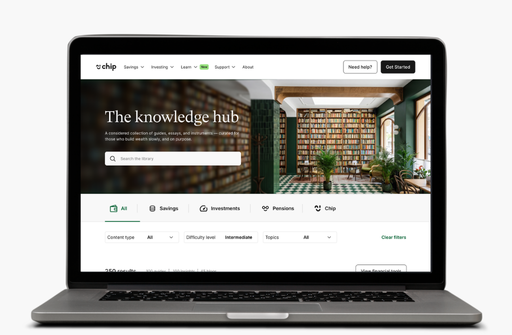
The knowledge hub

A considered collection of guides, essays, and instruments — curated for those who build wealth slowly, and on purpose.

0
results
Filter results
Filter by:
Content type
Difficulty level
Topics
0
results
View financial tools
The mastering your money mindset: Simple psychology for smarter saving
2 min read
Intermediate
Money Mindset & Lifestyle

We all have financial goals. Whether you're aiming for early retirement, paying off your mortgage, or growing your pension, the path to success depends on more than just numbers. 

It's about mindset. Managing money isn’t just about budgeting or resisting impulse buys; it’s about understanding your relationship with money. 

So, with that in mind, let’s explore some psychological strategies and simple tricks to help keep you on track with your savings goals.

‍

Discover your money personality

Each of us has a unique relationship with money, influenced by upbringing, experiences, and even cultural shifts. Some people naturally save, always preparing for the future. Others tend to spend impulsively, enjoying life in the moment.

To understand your money personality, reflect on how your family viewed money growing up.

Did your parents or friends have the same financial habits as you? Acknowledging your financial background can be eye-opening.

For example, in the 1980s, the average age of marriage in the UK was 25, while today it’s 34. Similarly, first-time homebuyers were 28 on average in the '80s, but now the typical age is 34.

These shifts mean our financial expectations have changed dramatically, but our attitudes may not have kept pace.

‍

Visualise your financial success

Imagine yourself in 10 years, living your dream life – perhaps you’re mortgage-free, retired early, or taking monthly holidays.

Visualisation is a powerful tool and can help turn long-term goals into daily motivators.

Create a vision board, save goal-related images on Pinterest, or stick a picture of your future dream on your fridge. Keeping these visuals front and centre will reinforce your motivation to stay committed to your financial journey.

‍

Break it all down

Achieving financial freedom doesn’t happen overnight – it requires small, consistent actions. Breaking down your big savings goal into manageable steps makes the journey less overwhelming.

Celebrate each milestone, whether it’s saving your first £1,000 or hitting 25% of your target. Each victory boosts your motivation and reinforces positive habits.

And, if you slip up or miss a goal, don’t beat yourself up. Life happens – what matters is bouncing back and focusing on the next milestone.

‍

Master delayed gratification

In a world of instant gratification, learning to delay is a game-changer. When faced with an impulse purchase, take a pause. Ask yourself how it will (or could) impact your future.

Your Chip app can help with this by showing you how far you’ve come, and what’s still ahead. If impulse control isn’t your strong suit, budget a little "fun money" each month. This way, you’re not depriving yourself, you’re just adding a delay to your gratification.

‍

Automate your savings

Set it and forget it. Automation is one of the easiest ways to grow your savings without thinking about it. Set up automatic transfers to your savings or investment accounts as soon as you get paid. This way, you learn to live off what’s left, while your wealth grows in the background.

Also, perhaps think about keeping push notifications on for your money apps so you can celebrate small wins when deposits are made. This can be a great daily reminder of your progress.

‍

Surround yourself with support

Money talk doesn’t have to be taboo. Surround yourself with friends or communities that share your financial goals. Whether it’s a local investment club or an online group, sharing ideas and strategies can keep you inspired and accountable.

Social media can be a great resource for connecting with others who are saving for similar goals. You can learn from their mistakes and successes, while also building a support network for those inevitable tough moments.

‍

Keep learning

Financial knowledge is empowering. Always try to keep learning, whether it's mastering tax laws, exploring different types of investments, or brushing up on budgeting tips. Staying informed can help you make smarter decisions and ensure you stay in control of your financial future.

Mastering your money mindset isn’t just about controlling impulse buys or following a rigid budget. It’s about aligning your financial actions with your long-term goals.

Every small step you take today is building a brighter future for yourself. Remember, the journey to financial freedom is uniquely yours. Celebrate each win, embrace the process, and keep your eye on the prize.

With the right mindset and tools—like the Chip app—your financial future can become more than just a dream.


What is a bear market?
2 min read
Beginner
Investing basics

A bear market is a period when a major market index, such as the UK's FTSE 100 or the US's S&P 500, falls by 20% or more from its recent highs. This market environment is characterised by widespread pessimism. Investor confidence is low, leading many to sell stocks, which in turn pushes prices down further. This is the direct opposite of a bull market, where prices are rising and optimism is high.‍

‍

When are we in a bear market?

Bear markets can only be identified retrospectively, once a market index has fallen more than 20%. It is a backwards-looking label rather than a real-time indicator. 

However, certain economic signals often precede or accompany a bear market. These can include:

  • Slowing economy: Key indicators like rising unemployment, a drop in corporate profits, and reduced consumer spending often signal an economic downturn that can lead to a bear market.
  • Rising interest rates: Central banks, such as the Bank of England, raise interest rates to combat inflation. This can make borrowing more expensive, cooling the economy and sometimes triggering a market downturn.
  • Geopolitical events: Major global events, such as wars or energy crises, create uncertainty and can cause investors to sell off assets in a flight to safety.

‍

How long do bear markets last?

There are different types of bear markets, and typically recovery times differ depending on the cause. Research from Goldman Sachs1 identifies three distinct categories of bear market based on historical stock market data:

  • Structural bear markets such as the Global Financial Crisis in 2007-2008 are triggered by a market imbalance and ‘bubbles’. By far the most severe type, average declines are around 60% and recovery time is around a decade. 
  • Cyclical bear markets are tied to rising and falling economic cycles, and can be triggered by economic headwinds such as rising interest rates, impending recessions, and declining profits. Average declines are around 30%, which last an average of two years, and take about five years to fully recover. 
  • Event-driven bear markets are triggered by single events such as wars, oil prices shocks, or a global crisis such as the Covid pandemic. Recovery periods are shorter, typically lasting around eight months, with full recovery in around a year. 

‍

What does bearish mean?

If you are a bear in the market, you are a stock market pessimist, and believe that prices are going to experience a downward trajectory. This is the direct opposite of being bullish, which is a belief that prices are heading upwards. 

A bear in the stock market might react differently depending on strategy and risk appetite. Some adopt a very high-risk strategy called short-selling, essentially betting on the falling price of a stock or market index, by borrowing shares from a lender, selling them on the open market, then selling them back to the lender at the (hopefully) lower price and profiting from the difference. 

Other bears might take a more defensive position, moving to ‘safe-haven’ assets such as cash and bonds, in an attempt to preserve or even grow capital during a market downturn.

‍

How to approach a bear market?

There is no one-size-fits-all approach to a bear market event, but for investors with a long-term horizon, the same key principles apply.

  1. Avoid panic selling: keeping calm in the event of a market downturn is crucially important if prices have already fallen, and selling will simply ‘lock in’ any losses you’re seeing in your portfolio. You risk missing the recovery period, and could derail your long-term goals. 
  2. Review your goals: if your financial goals are still years away, you likely have sufficient time to wait out the downturn. Familiarising yourself with the upward trends of the stock market over time can help put things in perspective.
  3. Stay diversified: spreading your investments across different asset classes and regions, can help cushion the impact of a bear market, particularly in event-driven circumstances that can be specific to an industry or market region. 
  4. Regular investments: continuing to invest a fixed amount, whatever the price, can help smooth out the ups and downs of the market. In a bear market, these investments are taking advantage of lower prices and potentially increasing returns when the market recovers. 

While bear markets can be unsettling, they’re a natural feature of the economic cycle, and can even present opportunities if navigated properly. Historically, bear markets in global markets have eventually been followed by a new bull market and a period of economic recovery, so staying the course if your financial goals allow it can be the best route for investors. 

‍

What is AER?
2 min read
Beginner
Rates, Tax & Economics

In this guide, we’ll look into what the Annual Equivalent Rate is, its significance in calculating interest, and how it differs from stated interest rates. By the end, you'll have a clear understanding of the AER and its implications for your savings.

‍

What Is the Annual Equivalent Rate (AER)?

The Annual Equivalent Rate, commonly known as AER, represents the estimated interest rate you would earn on your savings over the course of a year, assuming the interest is compounded and paid annually. 

It takes into account the frequency of interest payments and provides a standardised measure to compare different savings accounts or investment products on an equal footing. Interest rates explained here.

‍

How is AER calculated with monthly compounding interest?

When it comes to calculating the Annual Equivalent Rate (AER) with monthly compounding interest, it’s important to know the formula that’s used to calculate this. 

AER =[(1 + (Monthly Interest Rate))^12] - 1

Here’s a breakdown of calculating AER with compounding interest formula: 

Monthly Interest Rate: This is the nominal interest rate offered by the account, expressed as a decimal and divided by 12 (since there are 12 months in a year).
(1 + Monthly Interest Rate): This represents the factor by which your money grows each month. It's 1 plus the monthly interest rate.
^12: This exponent represents the number of compounding periods in a year (12 months).
- 1: Finally, subtracting 1 from the result gives you the AER, which is the annualised rate that takes into account the effect of monthly compounding.

Using this formula, you can calculate the AER for an account with monthly compounding interest and compare it to other accounts with different compounding frequencies to make more informed decisions about your savings.

‍

How does AER work?

For this example, imagine if you want to deposit £10,000 into a savings account. Account A offers an interest rate of 3.9% paid monthly, whilst account B offers 4% interest paid annually. 

Account A (3.9% interest paid monthly with compounding):

Calculate the AER for Account A:

  • AER accounts for the effect of monthly compounding.
  • Using the formula: AER = [(1 + Monthly Interest Rate)^12] - 1
  • AER for Account A is approximately 4.01%.

Interest earned in one year with Account A:

With a £10,000 deposit, you'd earn around £401 in interest over one year.

Account B (4% interest paid annually):

Since the interest is paid annually for Account B, the AER is equal to the nominal interest rate.

Interest earned in one year with Account B:

With a £10,000 deposit, you'd earn £400 in interest over one year.

Comparison:

  • Account A has an AER of approximately 4.01% due to monthly compounding, and you'd earn around £401 in interest over one year.
  • Account B offers a flat 4% interest rate, and you'd earn £400 in interest over one year.

In summary, even though Account A has a slightly lower nominal interest rate (3.9% monthly with compounding), its AER is slightly higher due to the effect of monthly compounding.

This results in competitive earnings compared to Account B, which offers a higher flat annual interest rate (4%). Check best interest rates for savings accounts.

‍

Annual Equivalent Rate vs. Stated Interest

The AER differs from the stated interest rate in that it takes into account the frequency of compounding. 

While the stated interest rate only represents the interest percentage applied to your principal amount, the AER considers the compounding effect and provides a more accurate reflection of the potential returns on your savings.

‍

Advantages and Disadvantages of the AER

AER offers several advantages:

  • Comparability: The AER provides a standardised measure that allows you to compare different savings accounts or investment products on an equal footing, considering the compounding effect.
  • Accurate interest calculation: By using the AER, you can estimate the actual returns on your savings over the course of a year, taking into account how often interest is added to your account.‍
  • Informed decision-making: With the AER, you can make more informed decisions about where to allocate your savings, as it provides a clearer picture of the potential growth of your money.

However, it's important to be aware of potential limitations:

  • Varied compounding periods: Different financial institutions may compound interest at different frequencies, making it crucial to compare AERs for accurate comparisons.‍
  • Changing interest rates: The AER assumes that interest rates remain constant over the year, which may not be the case. It's essential to consider the impact of potential interest rate fluctuations on your returns.

‍

AER Summary

The Annual Equivalent Rate (AER) is a vital tool for accurately comparing interest rates on savings accounts and investment products. By understanding the AER and its significance in calculating interest, you can make more informed decisions about where to grow your savings. 

Remember to consider the AER alongside other factors such as account terms, compounding periods, and potential interest rate fluctuations when evaluating your savings options. See Chip savings accounts.

The FSCS limit for savings is changing to £120,000
2 min read
Accounts & Products

From 1 December 2025, the Financial Services Compensation Scheme (FSCS) guarantee limit for savings is increasing from £85,000 to £120,000 per person, per bank.

The FSCS guarantee for investments is not changing and is remaining at £85,000.

You do not need to do anything to benefit from this change, it will be applied automatically by the FSCS.

We will update our content and materials shortly after 1 December 2025 to reflect the new limits.

‍

What does this mean for my money held in Chip?

The FSCS guarantee for savings is managed by the Bank of England and FSCS agency directly and they have stated the new limit will be in effect from 1 December 2025.

So, from then on, in the unlikely event that Chip, or our partners (ClearBank for savings and Seccl Custody Ltd.) should fail, you will be covered up to:

  • £120,000 of eligible deposits in your savings accounts, and;
  • £85,000 of eligible deposits in your investment accounts.

You can read more about how your money is protected at Chip here: https://getchip.uk/how-we-protect-your-money

‍

Your savings accounts

Four of Chip’s savings accounts are provided by our partner bank, ClearBank.

This means your FSCS cover across all savings you hold in Chip is £120,000 in total across all accounts from 1 December 2025. Please note, FSCS cover applies per person, per bank, so if you hold other accounts powered by ClearBank outside of Chip, your cover will also be shared across them.

You can hold larger deposits than the FSCS protection cover amount. Chip savings accounts balance limits are currently:

  • Chip Cash ISA: unlimited, but new deposits capped at £20,000 per tax year depending on your individual circumstances and subject to change in the future
  • Instant Access Account: £1 million
  • Easy Access Account: £1 million
  • Prize Savings Account: £85,000

You can read more about how ClearBank protects your money here. Please note that the Chip Cash ISA isn't available for new customers.

For the Smart Cash ISA: Money deposited into the Smart Cash ISA is held across established UK licensed banks, such as Barclays, Lloyds and HSBC and is eligible for cover by the Financial Services Compensation Scheme (FSCS), subject to FSCS conditions.FSCS limits of £120,000 per person, per bank apply, subject to eligibility. As funds may be held across multiple UK licensed banks, protection applies separately to deposits held with each bank.

‍

Your Chip investment accounts

The money in Chip investment accounts sits with a different firm (Seccl Custody Ltd.) than our savings accounts, so you enjoy separate FSCS cover for this money.

Your FSCS cover for investments is unchanged by this news and remains up to £85,000 of eligible deposits across all your investment accounts in Chip, so if you have both a Stocks & Shares ISA, and a General Investment Account (GIA) open, your cover is spread across both of those accounts.

As with savings, FSCS cover for investments applies per person, per institution, so if you hold investment accounts with Seccl Custody Ltd. outside of Chip, your total cover of £85,000 will also be spread across those.

You can hold more than the FSCS protection limit in Chip investment accounts. The total balance limits per account are currently:

  • Stocks & Shares ISA: unlimited, but new deposits capped at £20,000 per tax year depending on your individual circumstances and subject to change in the future
  • General Investment Account (GIA): unlimited

Remember, FSCS doesn’t cover you for investment performance, or in the event that your investments go down and you get back less than you put in.

‍‍

The savings FSCS limit increase comes into effect on 1 December 2025

The new £120,000 FSCS limit comes into effect on 1 December 2025.

You don’t need to do anything to benefit from this change, it will automatically be applied by the FSCS.

The Bank of England has set financial firms a deadline of May 2026 to update all their content, marketing materials and disclaimers to reflect the new limit.

However, we aim to update all of our content across our app, website, documents and automated emails as close as possible to 1 December 2025.

‍

The details

On midnight 18 November 2025 the Prudential Regulation Authority (PRA) from the Bank of England (BoE) announced the FSCS limit will increase from £85,000 to £120,000 from 1 December 2025.

The PRA is responsible for oversight of FSCS protection in respect of deposits for banks.

The PRA does not govern FSCS limits for investment accounts, which are determined by the FCA and there have been no announcements from the FCA about increasing the limits for investments.  

If this changes, we will also update you.

What's my replaceable ISA allowance?
2 min read
Savings Strategies & Tips

ISAs are the most popular savings product in the UK, but they aren’t always the easiest to understand if you aren’t familiar with the ins and outs.

Some Cash ISAs are flexible. That means if you take money out, you can put it back in again within the same tax year, without using up any of your annual £20,000 ISA allowance.

But your ‘replaceable ISA allowance’ goes beyond that. ‍

‍This is the extra "capacity" created when you withdraw money from a previous tax year. Instead of losing that tax-free space forever, you get a temporary window to put that exact amount back in without it counting as a new contribution.

‍

The previous tax year rules

If you have a large balance built up over several years, a Flexible ISA allows you to treat that "old" money with the same freedom as your current £20,000 allowance.

You can withdraw "old" money: Let’s say you have £50,000 from previous years, you can withdraw any amount of it, e.g. £30,000, and your "replaceable allowance" for the year effectively becomes £50,000 (£20,000 current limit + £30,000 old money).

‍The "same account" restriction: While you can pay current year replacements into different ISAs, you must pay previous year replacements back into the exact same account they were taken from.

‍The "use it or lose it" deadline: Regardless of how old the money was, the "flexible window" always slams shut on 5 April. If you withdraw £30,000 of old money in August 2025, you have until midnight on 5 April 2026 to replace it. If you miss that date, that £30,000 of "tax-free capacity" is gone forever.

‍

How the flexible money goes back in (the order)

HMRC has a "filling up" order for when you pay money back into a flexible ISA so you always know how its affecting you

  1. Replenish previous years first: Your deposits first "fill back up" any money you took out from previous years.
  2. Replenish current year next: Once old money is replaced, your deposits then cover any current-year withdrawals.
  3. New subscriptions last: Only after all withdrawals are replaced do your deposits start counting toward your fresh £20,000 annual limit.

‍

Why it can supercharge your tax-free savings

A replaceable ISA allowance gives you flexibility that many people don't realise they have.

In practice, this means you can pay in more than £20,000 in a single year, as long as part of that amount is replacing money you previously took out.

That flexibility makes your ISA a more adaptable tool for real life. You can use it for short-term needs, like a house deposit, home improvements, or a major life event, and still keep your long-term plans intact.

It can also be particularly useful if you have already used your £20,000 allowance for new money elsewhere and did not realise (or forgot) you still had the option to replace earlier withdrawals.

The key is knowing the allowance is there, and making use of it within the same tax year if it fits your situation.

What are gold and commodities?
2 min read
Intermediate
Asset classes

Why do people invest in gold?

Gold has held its appeal for thousands of years and for good reason. It’s often viewed as a safe haven1 (prices can fluctuate) investment that people turn to during periods of uncertainty.

Here’s why it continues to attract attention from investors:

  • Store of value: In times of economic crisis or market downturns, gold tends to retain its worth better than riskier assets.
  • Hedge against inflation: When inflation rises and currency loses purchasing power, gold has historically maintained or increased its value – acting as a financial hedge.2
  • Diversification: Gold doesn’t typically move in the same direction as stocks or bonds, making it a useful addition to a balanced portfolio.

1Investopedia

2Investopedia

‍

How to invest in gold in the UK

There are several ways to gain exposure to gold, depending on your preferences, budget, and investment goals:

1. Physical gold
  • Pros: Tangible, recognised globally, no counterparty risk (the chance that a party to a financial transaction, like a loan, investment, or trade, will fail to fulfill its obligations, potentially leading to losses).
  • Cons: Needs safe storage, insurance, can be less liquid than other options.
2. Gold ETFs, Gold ETCs and funds
  • Pros: Simple, cost-effective, easy to buy/sell like stocks.
  • Cons: Doesn’t give you access to physical gold. May involve price tracking errors or management fees.
3. Gold mining stocks
  • Pros: Potential for higher returns if gold prices rise.
  • Cons: Company-specific and operational risks. 
4. Gold savings accounts or digital vaults
  • Pros: Fractional ownership (an option to share between a number of investors), digital ease, lower entry point.
  • Cons: May have account or withdrawal fees, and depends on provider trustworthiness.

‍

Risks and disadvantages of investing in gold 

Like any asset, gold has its downsides. It’s important to understand these before diving in:

  • No income: Gold doesn’t pay dividends or interest – returns are confined to price growth (may be subject to Capital Gains tax).

  • Price volatility: Despite its ‘safe haven’ label, gold can still fluctuate in value based on market sentiment, interest rates, or geopolitical news.

  • Storage and insurance costs: Holding physical gold securely often comes with extra fees and responsibilities.

‍

Historical performance of gold

Gold has historically provided moderate long-term returns, though it can go through extended periods of underperformance. Over the past 20 years, gold has returned an average of ~12% per year.1

‍It has historically performed best during:

  • Inflationary periods
  • Currency devaluations
  • Market shocks or crises

1 J.P. Morgan

‍

Investing in other precious metals and commodities

Gold isn’t the only option when it comes to tangible assets. Other precious and industrial commodities can also play a role in your strategy.

Precious metals:
  • Silver – More volatile than gold, with both monetary and industrial demand.
  • Platinum & palladium – Used in manufacturing and clean energy tech, offering unique demand drivers.
Broader commodities:
  • Oil & natural gas – Linked to global energy prices. Prone to sharp swings but still essential to global economies.
  • Agricultural commodities – Wheat, coffee, sugar, and livestock can offer growth tied to global supply/demand shifts.

These can help hedge against inflation or add exposure to global growth – but also carry distinct risks based on weather, politics, or regulation.

‍

How to invest in commodities in the UK

You don’t need to stockpile barrels of oil or coffee beans to invest in commodities. Here are some beginner-friendly ways to get started:

  • Commodity ETFs/ETCs – Track the price of specific goods or baskets of commodities (e.g., gold, oil, agriculture).
  • Futures contracts – More advanced and high risk – these involve speculating on the future price of a commodity.
  • Commodity-producing companies – Invest in miners, energy producers, or agricultural businesses.
  • Physical metals – As mentioned, physical gold or silver remains popular for tangibility and trust.

‍

Gold and commodities in a diversified portfolio

Commodities behave differently than traditional assets like stocks and bonds – so they can add balance to your portfolio.

They’re often non-correlated, meaning they may rise when stocks fall (especially during inflation, currency shocks, or geopolitical events).

‍

Investing in gold and commodities summary

Gold and other commodities can be powerful tools for diversification, especially in uncertain economic times.

They don’t generate income like stocks or bonds, but they can help protect against inflation, currency weakness, or financial market shocks.

The right amount for your portfolio depends on your goals, risk tolerance, and time horizon. However, even a small allocation can go a long way in building resilience.

In the next guide of the series we take a closer look at cryptocurrencies and how they work. 

‍

FAQs
How can a beginner invest in gold?

ETCs, ETFs and other digital options can be great starting points due to their accessibility, low cost, and simplicity.

How do you invest in gold in the UK?‍

‍Options include buying physical gold (bars, coins), investing via ETCs, ETFs or funds, purchasing mining stocks, or using digital vault platforms.‍‍

Is gold the best investment?

Gold is a defensive asset so it can protect against market shocks. Best used as part of a wider, diversified portfolio.

What’s the difference between investing in gold and silver?

Gold is more stable and seen as a store of value. Silver has greater industrial use, tends to be more volatile, but can offer higher returns under certain conditions.

‍

Direct investment into gold and commodities is not available via the Chip platform.

What are bonds and how do they work?
2 min read
Intermediate
Asset classes

How do bonds work?

When a government or company needs to raise money, it can issue a bond. As an investor, you lend them a set amount and they agree to pay you a fixed interest rate (called the coupon) every year e.g. 3%. 

After a set number of years (the term), they pay you back the £1,000. This is known as the bond lifecycle: 

  1. Issuance – You buy the bond (or a fund that holds bonds). 
  1. Interest payments – You receive regular income, typically annually or semi-annually. 
  1. Maturity – At the end of the term, the bond is repaid in full. 

Bond prices can also rise and fall in value if traded on the secondary market. FDor example, if interest rates change or the issuer’s credit rating shifts.

‍

Types of bonds explained

Here are the main categories of bonds you’ll come across: 

  • Government bonds (gilts) – Issued by the UK government. Generally considered very low risk, but with lower returns. 
  • Corporate bonds – Issued by companies to raise funds. Riskier than gilts, but they usually offer higher interest. 
  • Green bonds – Used to fund environmentally-friendly projects. Growing in popularity among ethical investors. 
  • Index-linked bonds – Designed to keep pace with inflation, as the payments rise in line with a price index like the CPI. 
  • In the US: Savings Bonds, which are government-issued and often used for long-term savings goals. These differ from UK bonds in structure and taxation, and are only available to US citizens.

‍

Why invest in bonds?

Bonds can play a key role in a well-rounded portfolio. Here’s why: 

  1. Income generation – Regular interest payments can provide a steady stream of income. 
  1. Capital preservation – Bonds tend to be more stable than stocks, so they can help protect your investment. 
  1. Diversification – Adding bonds can smooth out the ups and downs of a stock-heavy portfolio. 

‍

Risks and disadvantages of bonds

Bonds are lower risk than stocks, but not risk-free. Here’s what to consider: 

  • Credit risk – The issuer might fail to pay interest or repay the loan (this is rare with government bonds, more possible with corporate bonds). 
  • Interest rate risk – If interest rates rise, existing bond prices can fall. Inflation risk – If inflation outpaces your bond’s return, your real purchasing power can shrink. 
  • Liquidity risk – Some bonds can be harder to sell quickly without losing value, especially in a downturn.

‍

How to invest in bonds (UK)

There are a few ways to invest in bonds as a UK investor: 

  1. Bond funds or ETFs – These are collections of bonds bundled together, offering easy access and instant diversification. 
  1. Direct purchase – You can also buy individual gilts or corporate bonds through some investment platforms. 
  1. Use tax-efficient wrappers – Investing through a Stocks & Shares ISA or a pension (not available with Chip) helps you keep more of your returns. 

‍

How do I invest in bonds? 

Start by choosing a platform, selecting a bond fund or individual bond, and deciding how much to invest. Funds and ETFs are often easier for beginners.

‍

Who should consider investing in bonds?

Bonds can suit a wide range of investors, including: 

  • Investors approaching retirement – Looking for steady income and capital protection. ‍
  • Cautious investors – Seeking lower volatility than stocks. ‍
  • Income-seekers – Wanting predictable returns through interest payments. 

If you’re someone with a lower risk tolerance or nearing a major financial milestone, bonds can provide valuable balance in your investment mix.

‍

Common bond-related terms explained

  • Yield – The return you earn from a bond, usually expressed as a percentage.‍
  • Coupon – The interest payment a bond pays, often annually.‍
  • Maturity – When the bond issuer repays the original amount borrowed.
  • ‍Par value – The bond’s face value, typically £100 or £1,000.
  • ‍Credit rating – An assessment of how risky a bond issuer is. Higher ratings mean lower risk.
  • ‍Bearer bonds – Rare today, these are unregistered bonds where whoever holds the paper owns the bond.
  • ‍Duration – A measure of a bond’s sensitivity to interest rate changes.
  • ‍Callable bonds – Bonds the issuer can repay early, which can affect returns.

‍

Investment bonds summary

Bonds are a type of investment where you lend money to a government or company in exchange for interest payments. 

They’re generally lower risk than stocks, making them popular for income, stability, and diversification. While they come with their own risks, like interest rate changes or inflation, bonds can play a key role in your long-term financial plan.

In our next guide, we’ll cover exchange-traded funds (ETFs), what they are, how they work, and why they’re one of the most popular investment choices for both beginners and seasoned investors. 

‍

FAQs

What are bonds in simple terms? 

Bonds are loans you give to a government or company. In return, they pay you regular interest and repay your money after a set time.

Are bonds a good way to invest? 

Yes, especially if you're looking for stability and income. They may not grow as fast as stocks, but they’re generally lower risk.

How do beginners invest in bonds? 

The easiest way is through bond funds or ETFs on an investment platform. You can also use a Stocks & Shares ISA to invest tax-free.

What are the disadvantages of bonds? 

Bonds carry risks like interest rate changes, inflation, and defaults. Some can also be harder to sell quickly if you need access to your money.

‍

Biggest companies in India by market cap
2 min read
Expert
Global cap giants

What are the biggest companies in India by market cap?

This list ranks the biggest public companies in the Indian market by market capitalisation. We’ll also highlight other key figures, such as revenue, gross profit, and 1-year return. Key facts like the company's exchange, founding year, and country are also covered.

‍

1. Reliance Industries Ltd. (RELIANCE)

  • Market cap: $209.8 billion
  • Revenue: $108.41 billion
  • Gross profit: $29.94 billion
  • 1-yr return: -10.23%
  • Exchange: NSE
  • Year founded: 1957
  • Country: India

India’s largest and most valuable company, a globally reaching conglomerate with influence spanning energy, tech and consumer services. 

  • Oil-to-chemicals: This is Reliance’s core and most profitable division. It operates the world’s largest single-location oil refinery, and produces everything from transportation fuel to plastics, providing huge streams of cashflow to other areas of the business. 
  • Reliance Retail: India’s largest retailer with over 18,000 stores across the country, supplying its customers with groceries, electronics and fashion.
  • Jio Platforms (digital services): The largest mobile network operator in India with over 450 million subscribers, offering telecoms, streaming services (JioCinema), payment apps, and other online services. 

‍

2. HDFC Bank (HDFCBANK)

  • Market cap: $163.47 billion
  • Revenue: $54.83 billion
  • Gross profit: N/A
  • 1-yr return: +8.76%
  • Exchange: NSE
  • Year founded: 1994
  • Country: India

India’s largest private-sector bank by assets, operating a broad spectrum of banking services with a strong focus on both individual consumers and large corporations. 

  • Retail banking: serves over 80 million customers across India with current and savings accounts, personal, car and business loans, and credit cards. 
  • Wholesale banking: provides medium and large-sized businesses, corporations and institutional clients with capital loans, trade finance, cash management solutions, and investment banking services.
  • HDFC merger: HDFC Bank merged with HDFC Ltd. — India’s largest housing finance company — in 2023. This gave HDFC Bank a massive book of home loans, making it a leader in the mortgage market.

‍

3. Bharti Airtel Ltd. (BHARTIARTL)

  • Market cap: $122.05 billion
  • Revenue: $20.87 billion
  • Gross profit: $8.28 billion
  • 1-yr return: +9.59%
  • Exchange: NSE
  • Year founded: 1995
  • Country: India

One of the world’s leading telecommunications companies, with a significant presence across South Asia and Africa. In the Indian market, Airtel is a key rival of Reliance Jio, in mobile, broadband and digital services. 

  • Airtel India: serves over 300 million subscribers with mobile services, broadband, digital TV and payment services through their ‘Thanks’ app. 
  • Airtel Africa: leading telecom and money provider across 14 countries in Africa, providing mobile and data services, alongside mobile payments that allow users to transfer money, pay bills, and access other financial services. 

‍

4. Tata Consultancy Services Ltd. (TCS)

  • Market cap: $117.99 billion
  • Revenue: $28.81 billion
  • Gross profit: $9.1 billion
  • 1-yr return: -32.62%
  • Exchange: NSE
  • Year founded: 1968
  • Country: India

A huge IT services and consulting company, part of the huge Tata Group multinational conglomerate. They rival big firms like Accenture and IBM as a global tech services leader.

  • IT services and consulting: providing a range of tech solutions to multinational corporations globally, with their cloud infrastructure, cybersecurity, data and analytics and bespoke software development.
  • Business and industry solutions: specialises in tailored industry-specific solutions, particularly within banking and financial services, and insurance — this is their largest source of revenue. They also have clients within retail, manufacturing and healthcare, helping them manage core processes like supply chain and customer relations. 

‍

5. ICICI Bank Ltd. (ICICI)

  • Market cap: $108.28 billion
  • Revenue: $32.98 billion
  • Gross profit: N/A
  • 1-yr return: +4.33%
  • Exchange: NSE
  • Year founded: 1955
  • Country: India

One of India’s largest private-sector banks and a key player in the country’s financial system. A key competitor of HDFC Bank and the State Bank of India.

  • Retail banking: provides millions of customers with current accounts, savings accounts, personal loans, mortgages, and credit cards. It has a strong digital product presence from its iMobile Pay app, that provides a wide array of payment and banking services.
  • Corporate and institutional banking: Provides financial solutions to businesses of all sizes, including working capital finance, and term loans, alongside cash management and trade finance services to aid business operations. 

‍

6. State Bank of India (SBIN)

  • Market cap: $90.5 billion
  • Revenue: $74.06 billion
  • Gross profit: N/A
  • 1-yr return: +8.8%
  • Exchange: NSE
  • Year founded: 1921
  • Country: India

India's largest public-sector bank and a cornerstone of the nation's financial system. With its unparalleled reach across the country, it is a dominant force in both retail and corporate banking.

  • Retail banking: Serves a massive customer base of over 450 million people through an extensive network of more than 22,000 branches. It is a leader in personal banking, offering services from basic savings accounts and home loans to wealth management, and operates the popular YONO digital banking app.
  • Corporate banking and treasury: Acts as the primary banker to many of India's largest corporations and state-owned enterprises, providing project finance, working capital loans, and treasury services. Due to its government ownership, it plays a key role in financing national infrastructure and industrial projects.

‍

7. Bajaj Finance Ltd. (BAJFINANCE)

  • Market cap: $69.45 billion
  • Revenue: $7.75 billion
  • Gross profit: $4.88 billion
  • 1-yr return: +28.96%
  • Exchange: NSE
  • Year founded: 1987
  • Country: India

One of India's largest and most diversified non-banking financial companies (NBFCs). A leader in consumer finance, it is renowned for its rapid growth and use of technology to provide instant loans to millions of customers.

  • Consumer lending: This is the company's core business, offering a vast array of financing options directly to consumers. It is a dominant player in providing instant loans for electronics, home appliances, and furniture at thousands of retail stores, as well as offering personal loans and credit cards.
  • SME and commercial lending: Provides a range of financial solutions to small and medium-sized enterprises (SMEs) and commercial clients, including working capital loans and financing for business expansion. It also has a significant presence in lending to real estate developers. 

‍

8. Infosys Ltd. (INFY)

  • Market cap: $67.31 billion
  • Revenue: $18.34 billion
  • Gross profit: $5.69 billion
  • 1-yr return: -23.31%
  • Exchange: NSE
  • Year founded: 1981
  • Country: India

A global leader in IT services and consulting, and one of the most prominent technology companies to emerge from India. It is a major competitor to other IT giants like TCS, Wipro, and Accenture.

  • Digital services and consulting: Focuses on helping large businesses modernise their technology through "digital transformation." This includes moving clients to the cloud, implementing AI and data analytics solutions, and enhancing cybersecurity.
  • Core enterprise services: Manages the foundational IT operations for its global clients. This involves application development and maintenance, modernising legacy systems, and outsourcing business processes to improve efficiency.

‍

9. Hindustan Unilever Ltd. (HINDUNILVR)

  • Market cap: $66.07 billion
  • Revenue: $7.07 billion
  • Gross profit: $3.16 billion
  • 1-yr return: -15.17%
  • Exchange: NSE
  • Year founded: 1956
  • Country: India

India's largest Fast-Moving Consumer Goods (FMCG) company and a subsidiary of the British multinational, Unilever. Its products are a household staple, reaching nine out of ten Indian homes.

  • Home and personal care: This is HUL's largest division, encompassing a vast portfolio of iconic brands. It includes soaps and skincare (Lifebuoy, Lux, Dove), laundry detergents (Surf Excel, Rin), and surface cleaners (Vim).
  • Foods and refreshment: HUL is a major player in India's food and beverage market. Key brands include Brooke Bond and Lipton teas, Bru coffee, Knorr soups and noodles, and Kwality Wall's ice cream.

‍

10. Life Insurance Corp. of India (LICI)

  • Market cap: $63.7 billion
  • Revenue: $101.18 billion
  • Gross profit: N/A
  • 1-yr return: -11.9%
  • Exchange: NSE
  • Year founded: 1956
  • Country: India

India's largest state-owned life insurer and a dominant force in the country's insurance sector. As a household name, it is one of the biggest institutional investors in the Indian stock market.

  • Insurance and pension plans: This is LIC's core business, offering a vast range of life insurance policies, annuities, and pension plans to millions of individual customers. It operates through an extensive network of over a million agents, giving it enormous reach into both urban and rural India.
  • Investment operations: LIC manages a colossal investment portfolio, making it a cornerstone of the Indian economy. It invests the premiums collected from policyholders into government securities and equities, making it one of the largest single investors in many Indian companies.

‍

What are the biggest companies by total annual revenue?

  • Reliance Industries Ltd.: $108.41 billion 
  • Life Insurance Corp. of India: $101.18 billion 
  • Indian Oil Corp Ltd.: $85.38 billion 
  • State Bank of India: $74.06 billion 
  • Oil & Natural Gas Corp. Ltd.: $69.03 billion

‍

What are the biggest companies by workforce?

  • Tata Consultancy Services Ltd.: 607,980
  • Quess Corp. Ltd.: 441,150 
  • Larsen & Toubro Ltd.: 412,970
  • Infosys Ltd.: 323,580 
  • Petrobras: 236,230

‍

Summary

Understanding a company's performance is crucial; it's how you truly know what you own. These metrics directly drive the value of your stocks and funds. When you understand these key drivers, you can navigate market changes with confidence, rather than just reacting to headlines.

Next we’ll be looking at the biggest companies in Europe by market cap.

All market data sourced from TradingView and company reports as of 30.09.2025.

We're removing support for older versions of iOS
2 min read
Accounts & Products

We need to stop supporting Chip on an older version of Apple Operating System (OS), iOS 15. This is due to it no longer being supported by Apple’s security updates.

If your device is on iOS 15, and you don’t / won’t / can’t update to a newer version of iOS, you no longer be able to access your Chip app.

This is most likely to affect you if your phone is around 10 years old, and/or you don’t have automatic iOS updates switched on.

‍

What this means

This means after 23 July 2025 you won't be able to log in to Chip using a device running iOS 15 unless you update to a newer version of iOS.

If you use an older Apple device (i.e. around 8-10 years old) you may need access to a newer device that supports a  newer version of iOS, as older Apple devices don’t always support the newer operating systems.

‍

How to find which version of iOS you're on

You can double check this on your phone by navigation Settings > General > About and look for ‘iOS Version'.  

Apple offers a guide to find the software version on your iPhone, iPad or iPod touch.

‍

How to update

It’s easy to update your phone, simply open your device, go to Settings > General, then tap Software Update.

Apple offers a clear and simple guide here, which also covers how to switch on automatic iOS updates.  

‍

Why are we doing this?

If you’re confused about the above, here’s a quick explanation.

Your device’s software is powered by an Operating System (OS) called iOS, which is built and maintained by Apple.

Apple regularly releases new versions of iOS to make your phone work better and keep you safe. The latest version is iOS 18.

Apple no longer maintains or releases security updates for iOS 15.

This means we can’t guarantee the security of Chip accounts using our app on devices running iOS 15.

‍

What if you can't update?

After 23 July 2025 you won't be able to log in to Chip on a device running iOS 15.

You should be able to update your device to a newer version of iOS, but if your phone is 8-10 years old you may need to get access to a newer, supported device.

If this is not possible for you, you may wish to consider withdrawing your money and closing your account before 23 July 2025.

However, if you don’t withdraw, your account will remain open and secure, and you'll be able to access it at any time using a newer device.

Finally, as a Chip customer you can contact us in writing or via email to withdraw your money (note there will be additional security measures and identification you’ll need to provide).

If you have any further questions don’t hesitate to drop into your in-app customer support.

Thank you! Your submission has been received!
Oops! Something went wrong while submitting the form.