



.avif)







Moonshot capitalism: AI rewrites the venture capital playbook
Tech investors are rediscovering the kind of long-shot sci-fi bets that helped build Silicon Valley
%202.png)


Not to be redistributed, copied or modified in anyway. FT and Financial Times are trademarks of the Financial Times Limited.
Chip has hosting rights to certain limited Financial Times articles. This is not a live feed of Financial Times content.
All commentary and opinions are those of independent FT journalists and experts, not those of Chip. Chip does not give financial advice.
The AI boom is fuelling a resurgence in ambitious “moonshot” bets, as early SpaceX backers’ huge returns and falling valuations for traditional software companies force tech investors to embrace riskier and more capital-intensive dealmaking.
Ideas once considered outlandish, from nuclear fusion to melding humans with machines, are gaining attention from venture capital firms that even a few years ago would never have touched start-ups in such sectors.
“The world definitely has changed,” said Matt Robinson, partner at VC firm Accel. “Look inside any VC’s office and the kind of companies they are discussing over the last couple of years has transformed.”
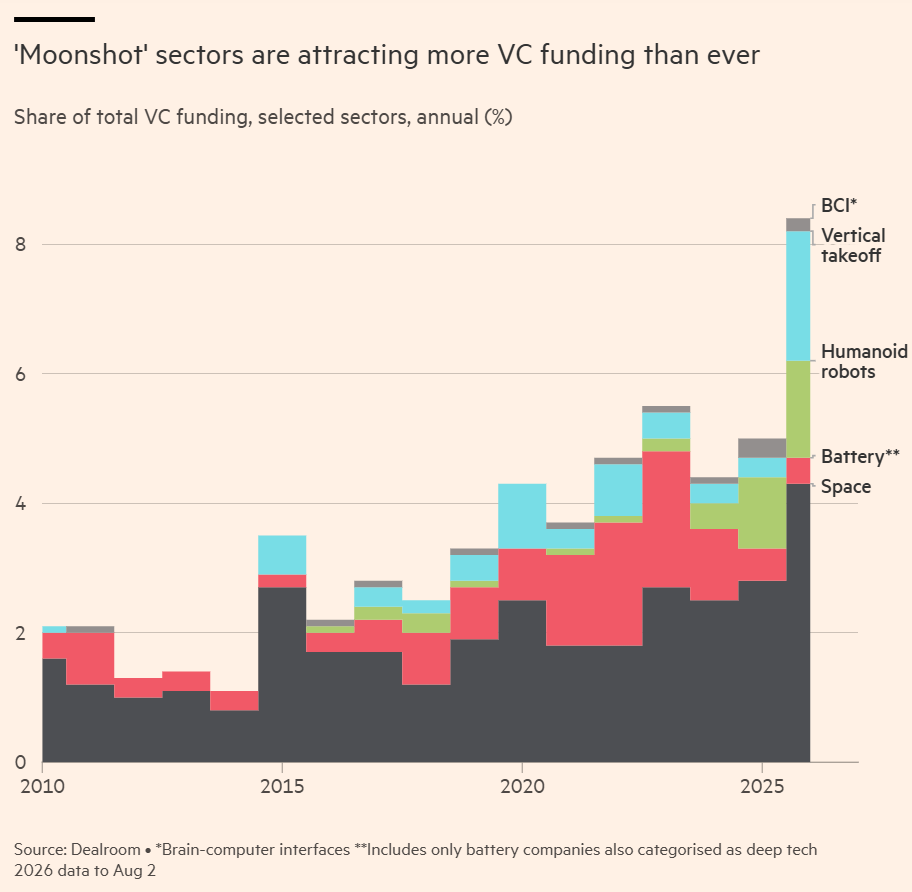
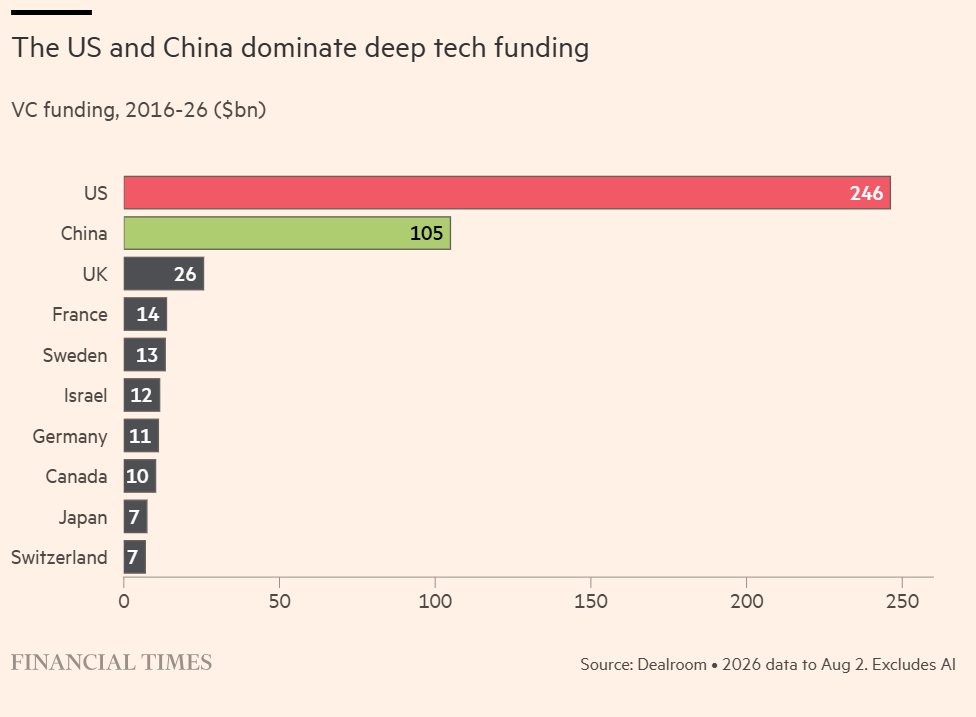
Excluding the giant sums ploughed into AI start-ups, global investment in “deep tech” — companies whose products are rooted in big scientific or engineering advances — has exceeded $150bn since the start of 2024, more than the $133bn in the entire decade to the end of 2019, according to Dealroom.
Ambitious founders in Silicon Valley are cheering a return to greater risk-taking from investors, after an extended stretch following the dotcom bust in which VCs became preoccupied with backing predictable enterprise software companies.
“The most profitable [start-ups] to invest in were all software businesses on the internet for a period of time, when the internet was new and growing,” said Max Hodak, co-founder of Science, a brain-computer interface start-up. “That sucked a lot of oxygen out of physical hardware because it’s harder . . . Was that totally healthy? Probably not — but we’re back.”
Hodak, who also co-founded Neuralink alongside Elon Musk, argues that VCs’ interest in software was itself a “detour” from the hardware ventures that helped Silicon Valley emerge decades ago.
“The original ‘OG’ venture capital built the railroads. This is really the magic of capitalism,” he said.
This year’s deep-tech investments have not yet surpassed 2021’s peak, which was propelled by battery and electric vehicle deals for the likes of Rivian and Northvolt — many of which turned sour, highlighting the risks involved in moonshot dealmaking.
But the extraordinary volumes of capital flowing into AI model companies are spurring a rise in bets that could revolutionise how data centres are powered or even put them into space, as well as reviving interest in other science-fiction ideas that AI promises to bring closer to reality.
“There is a feeling of turning the oil tanker,” said one VC executive specialising in “frontier” tech of the sense among investors that they have to move beyond software-as-a-service.
“But it’s such a different thing to underwrite a quantum computing company to something where you’ve had such a strong set of benchmarks that you could put in a spreadsheet.” The AI infrastructure boom in particular has created new markets and customers for all kinds of wild ideas.
“Today there is almost a ‘why now’ for everything,” Robinson said. “You used to be able to say, this one goes in the too-hard bucket. And I don’t think you have that option any more.”
AI-powered simulations are already slashing the cost of experimenting in areas such as fusion and space tech, lowering the upfront spending requirements that have traditionally been associated with hardware ventures.
AI is “really transforming what you can do ‘in silico’ before you do it in the physical world,” said Carina Namih, investor at London-based VC Plural. “That is driving a massive acceleration in those deep-tech fields. So the capital intensity to get those returns has really changed.”
But the timeline to cashing in those returns remains uncertain. Raising capital for moonshot ideas may be getting easier but the path to commercialisation is often just as hard as the initial tech breakthrough.
Alphabet’s X lab popularised the idea of moonshot investments more than a decade ago, when Google’s parent company created an incubator for long-shot ideas that traditional investors rarely backed. It has produced both hits — such as Waymo, the self-driving car venture now valued at $126bn — and misses including Loon, which had hoped to deliver internet access to remote areas via high-altitude balloons before it was shuttered in 2021.
But even Google’s starry-eyed approach to innovation is now becoming more grounded. In a recent interview with Fast Company, Alphabet’s “captain of moonshots” Astro Teller said X now spent more time studying the business case and technical feasibility of its latest ideas, which include Bellwether, an AI-driven forecasting system aimed at predicting natural disasters.
Moonshot investors concede there is no traditional valuation metric that can win over an investment committee when it comes to ideas like putting data centres or biology labs in space. Writing a speculative cheque is often the only way to see which science project might turn into the next SpaceX.
Some of this year’s biggest deep-tech deals outside of AI include space start-ups Sierra Space, Axiom Space and Iceye, as well as fusion start-ups Helion, Proxima and Inertia.
“One of the things everyone considered very difficult about the space industry, until now, was there was a very high barrier to entry,” said Ariel Ekblaw, chief executive of space architecture R&D lab the Aurelia Institute and an investor in space tech, noting that in the AI era, “entire products . . . can be rebuilt in a day”.
The wealth created by the SpaceX IPO is fuelling a fear of missing out among “people who did not get invested in that first wave”, Ekblaw added, predicting this would spark a “Cambrian explosion of new start-ups” targeting the space industry. Founders Fund, for example, turned a roughly $600mn investment in Musk’s rocket, satellite and AI group into a stake worth more than $50bn at the company’s initial public offering, according to PitchBook estimates.
Ekblaw predicts that falling launch costs will unlock new applications for the space industry, from energy to in-space manufacturing.
“There is a real need for more orchestration of solar power in orbit between space assets that enables high-power activities . . . that were not happening before,” she said. “The corollary to that is space-to-ground, which is profoundly more efficient green energy and you can do it even at night.”
Start-ups such as Overview Energy and Reflect Orbital are planning to float giant mirrors in orbit that would reflect sunlight back to Earth, while Florida-based Star Catcher raised $65mn in May to build a power grid in space using “optical power beaming”.
“We are going to see a maturation of the space industry, like we did with commercial aviation,” said Ekblaw. “We are in the early stages of that transition.”
Bouncing sunlight around in orbit might seem like less of a daunting investment prospect for portfolio managers whose software stocks have been hammered by this year’s “SaaSpocalypse”, which wiped away hundreds of billions of dollars in market value. Some of those losses were recouped after last month’s earnings reports from the likes of Salesforce.com showed a potential uplift from AI.
AI model companies such as Anthropic could end up swallowing much of the market served by today’s traditional software companies, according to Bejul Somaia, partner at Lightspeed Venture Partners.
“On the applications side, one of the biggest and most difficult things to underwrite right now in software-only businesses is durability and differentiation,” he said. “Where will the models end?”
As AI threatens to destroy many of the “moats” that traditional software incumbents have relied on to protect their businesses, many tech investors now argue that venture capital must also reinvent itself for a new, less certain era in the tech industry.
“In category after category, the terminal value we once counted on no longer holds,” Hemant Taneja, who heads VC firm General Catalyst, wrote in an essay in July. “For an outcome to matter now, founders must build far bigger companies than before.”
Hodak, who is preparing to bring to market Science’s first product — a retinal implant that can restore sight — bristles at the “moonshot” label.
“Just because it’s a big ambitious goal, I don’t think it needs, in the psyche of the popular imagination, to mean it’s unlikely,” he said.
“The original moonshot worked. We did in fact leave a flag on the moon.”
%202%20(2).png)
%202.png)