










‘Bold but sane’: what we learnt from Anthropic’s 240,000-word IPO filing
Prospectus details AI lab’s ‘mission’, $800bn data centre commitments and extraordinary governance structure



Not to be redistributed, copied or modified in anyway. FT and Financial Times are trademarks of the Financial Times Limited.
Chip has hosting rights to certain limited Financial Times articles. This is not a live feed of Financial Times content.
All commentary and opinions are those of independent FT journalists and experts, not those of Chip. Chip does not give financial advice.
Anthropic has unveiled its long-awaited listing prospectus, detailing over more than 300 pages how its technology could cure disease and grow the economy, provided it does not first cause “catastrophic or existential risks to humanity”.
The filing puts Anthropic on track for a blockbuster listing next month. The initial public offering on Nasdaq, under the ticker ANT, will serve as a referendum on whether public market investors are sold on the visionary zeal with which Dario Amodei’s AI lab has wooed private backers.
Investors will have to swallow a complex governance structure that gives ordinary shareholders almost no power, as well as extraordinary financial and societal risks.
Alongside dizzying growth and $800bn in data centre spending commitments, the company’s founders urge prospective owners of the stock “not to think of your purchase in purely transactional terms”. Here is what we learnt from Anthropic’s S-1.
Selling a unique culture and mission
Anthropic’s filing plays up its mission to responsibly develop AI for the long-term benefit of humanity. The company’s seven-strong founding team, who left OpenAI to launch their own safety-orientated rival in 2021, said in the S-1 that “all of our efforts are guided by a singular focus on our mission”.
The founders framed this focus as a key advantage over rivals, helping the business compete for talent and remain focused on the “highest-value work for humanity”. They also highlighted that their continued presence at the top of the lab was “uncommon”, a subtle dig at rival OpenAI, which has lost the majority of its founding team.
"We are first and foremost a research lab—our mission is the responsible development and maintenance of advanced AI for the long-term benefit of humanity. This mission directs our focus—along with our talent and culture, our frontier and safety research, our approach to compute, and our enterprise strategy, it is one of the core advantages that set us apart."
Among an extensive list of risk factors, Anthropic cautioned that any diversion from the mission caused by competitive pressures, senior departures or the rapid growth of the company could undermine a culture which “is a critical component to our success”.
Financial performance
The S-1 provided the clearest picture yet of Anthropic’s soaring revenue, which rose from $4.6bn last year to more than $33bn in the nine months to the end of September, according to the filing and figures recently shared with investors. Revenue per head at the five-year-old group over the past year is $6.6mn.
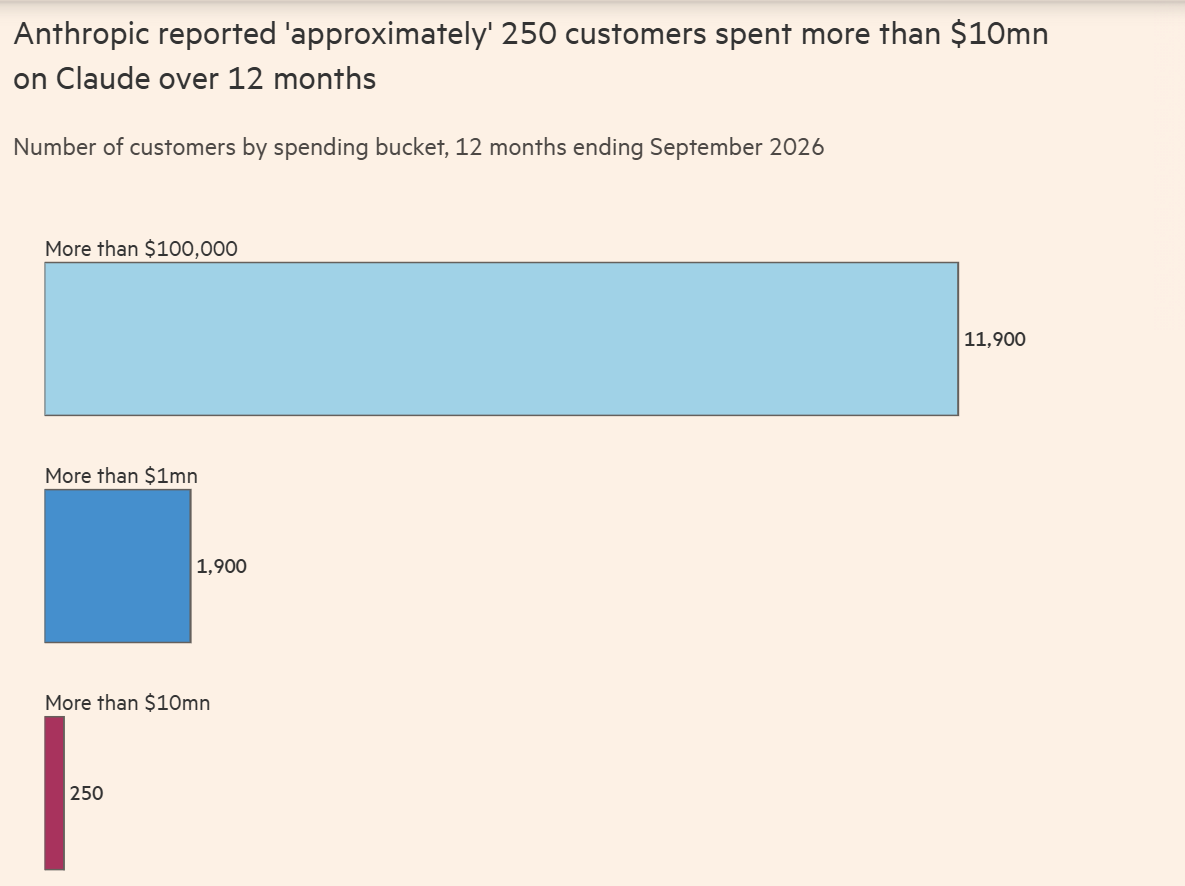
But there is a significant risk underlying that rapid growth. Just five customers accounted for 25 per cent of revenue in the first nine months of the year, while only 250 spent more than $10mn on an annual basis. Anthropic also warned that its rapid growth to date “may reflect early-stage adoption”, and could stall in the months to come.
Its revenue growth has slowed this year. After more than doubling between the first two quarters of 2026, revenue grew almost 50 per cent between the second and third quarters.
Anthropic’s founding team also warned that their decisions “may run counter to investors’ expectations” because profit maximisation will be balanced by “the public good” and “business bets [may] seem strange or unorthodox in isolation”.
Pushing for profitability
To support its spending in the near term, the start-up has a cash pile of $112bn on hand. Anthropic is pushing to become profitable, focusing on using its scarce computing power more efficiently, including by using its AI model Claude to train newer models.
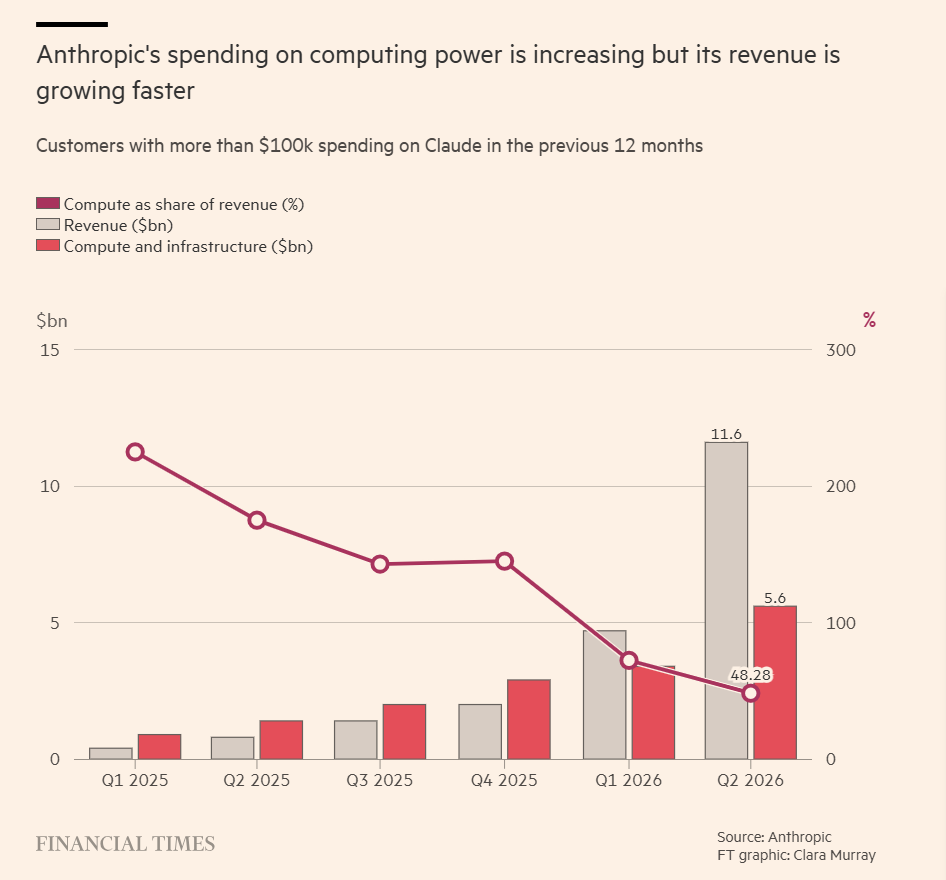
Anthropic spent just over $2.50 on computing power and infrastructure for every $1 of revenue in the first quarter of 2025. During the second quarter of 2026, that was down to less than 50 cents.
There are signs the efficiency drive is working. Anthropic’s operating margin was 8 per cent and operating income was $1bn for the three months ended June 30, compared to a loss of $1.2bn for the same period a year earlier.
Its performance was, however, likely to “fluctuate significantly on a period-to-period basis” as a result of spending on computing resources, it said.Computing power ‘the critical input’
Anthropic identified computing power as “the critical input” for its business. Its hunt for chips and data centres has driven a wave of deals, with the AI lab signing up to commitments worth more than $800bn and stretching as far as 2045.
The founders acknowledged that their compute investments “may seem irresponsibly large at first glance”, but described their approach as “bold but sane”.
Its largest commitment is with Broadcom, which co-develops the TPU AI processors with Google and leases them to Anthropic in deals worth $161bn over five years. From 2028, Anthropic expects to spend up to $150bn more on TPUs.
Anthropic also expects to spend more than $20bn on AMD chip systems, with an option to roughly double that. AMD will in turn invest up to $5bn in Anthropic as its chips are delivered.
The AI lab’s deals with SpaceX are worth up to $120.5bn through to 2029 and will cost about $3.1bn a month once all the capacity comes online, which Anthropic expects in December. Either side can walk away on 90 days’ notice from early next year.
Google, Amazon and Microsoft will provide at least $269.4bn of cloud compute over the next decade, while deals with upstart cloud providers Nscale and Lambda are worth up to $86bn.
Big winners
Assuming Anthropic lists at a $2tn valuation, which is far from guaranteed, its longtime funders, including the tech groups that supply its computing power, are set to benefit.
Its largest hyperscaler backer is Amazon, which would own about a fifth of the company if its convertible notes were fully converted — worth about $400bn at a $2tn valuation. Its holding is capped at 12 per cent, with the excess kept in notes that convert only as room opens up under the limit. But Amazon can waive that cap.
Next comes Google, which has a roughly 7 per cent stake. That could still rise as the search giant invests up to $20bn more under deals struck earlier this year. It could commit $10bn at the listing price, or into the IPO itself if both sides agree to make Google an anchor for the public offering.
Among financial investors, the filings indicate Spark Capital invested less than $1bn for a stake worth $14.5bn. It is a similar-sized holding to that of Coatue, which invested $4.75bn, according to a person familiar with the matter.
Like SpaceX, Anthropic has opted to stagger when insiders can sell their equity into the public market, with five release dates within the first 76 days of trading. Non-founder directors, officers and some current and former employees will be free to sell a chunk of shares on Anthropic’s market debut. Companies typically stipulate that early investors can first begin selling down their stakes 180 days after an IPO.
‘Novel’ governance
Anthropic admits its “novel” corporate governance structure “differs significantly” from most other public companies. It gives ordinary shareholders virtually no control over the company’s decisions.
At the top of the structure sits a “Long-Term Benefit Trust”, which appoints its own members and generally has the power to elect and remove four out of the seven directors on Anthropic’s board.
The current trustees include Ben Bernanke, former chair of the US Federal Reserve, and Christopher Stubbs, professor of physics and astronomy at Harvard University.
"We [have] implemented an innovative governance structure featuring the Long-Term Benefit Trust, which is designed to ensure that we are managed in a manner that responsibly balances our tripartite goals as a public benefit corporation: the pecuniary interests of our stockholders, the best interests of those materially affected by our conduct, and the Company Purpose."
Neither chief executive Dario Amodei nor his sister Daniela, a co-founder, can be removed from the board by the LTBT.
The remaining three board members will be elected by shareholders, but in practice will be chosen by the Amodei siblings and the five other co-founders, who will retain day-to-day control of the company through a special class of stock that grants them 50.1 per cent voting power.
The trust’s control over the fourth board seat — and the casting vote — is limited by a requirement that the board’s nominating committee, which includes Daniela Amodei, agrees with its decisions. In case of disagreements, a vote representing employees breaks the deadlock.
Existential’ risk factors
The S-1 includes 92 pages of “risk factors” which depart wildly from the often boilerplate disclosures companies make to protect against future legal claims.
Anthropic’s risk disclosures, which were roughly three times longer than SpaceX’s, include an extraordinary warning that its technology may pose “catastrophic or existential risks to humanity” and “provide meaningful assistance to malicious actors seeking to develop chemical, biological, or other dangerous weapons”.

It also described how it may lose control of its own products.Models might one day exhibit “unexpected . . . self-preserving behaviours, including attempts to resist shutdown, conceal or manipulate information” or could generate “coercive, deceptive” outputs that resemble “blackmail”, Anthropic’s filing said.
Anthropic warned that it may be impossible for any single insurer or even the insurance industry as a whole to underwrite these risks.
"Concerns have been raised both within our organization and by other researchers, regulators, policymakers, and industry participants that sufficiently advanced AI systems could, if not developed, deployed, and operated with appropriate safeguards, oversight, and security measures, pose catastrophic or existential risks to humanity, particularly if such systems were misused, replicated, weaponized, or allowed to operate with a high degree of autonomy."
The filing also acknowledges that the US administration could increase costs, restrict Anthropic’s operations or enact new regulations that influence demand for its models. Earlier this year, Anthropic was designated a “supply-chain risk” by the US Department of Defense. Income from government agency contracts accounts for about 1 per cent of Anthropic’s revenue, the S-1 adds.
“Many of the risks we face are interconnected and may compound or trigger cascading adverse effects,” Anthropic concludes.