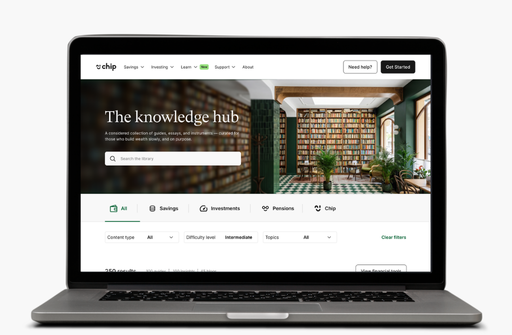
The knowledge hub

A considered collection of guides, essays, and instruments — curated for those who build wealth slowly, and on purpose.

0
results
Filter results
Filter by:
Content type
Difficulty level
Topics
0
results
View financial tools
What is a Savings Account?
2 min read
Beginner
Accounts & Products

How does a Savings Account Work?

Banks tend to offer a range of savings accounts with various interest rates. When you deposit money into a savings account, the bank will usually pay a small amount of interest on that money, which means that your balance will grow over time.

You can usually withdraw money from a savings account at any time unless it’s an account which requires you to send a notice to withdraw funds.

In general, savings accounts are a safe and easy way to help save money and earn interest on that money too. Learn some money saving tips.

What Types of Savings Accounts are available in the UK?

There are a variety of savings accounts available in the UK. Some of the more common accounts are:

  1. Easy Access Savings Account: This type of savings account allows you to deposit and withdraw money at any time, typically with no notice period or penalty for withdrawals. They usually have no minimum deposit requirements. Learn more.
  2. Notice Savings Accounts: These accounts require you to give notice before making a withdrawal, usually 30, 90 or 120 days. Notice accounts tend to have a higher interest rate than easy access accounts.
  3. ISA (Individual Savings Account): ISAs are tax-free savings or investment accounts that allow you to save money without paying tax on the interest earned. There are different types of ISAs, such as cash ISA or stocks and shares ISA.

Chip does not provide tax advice. Tax treatment depends on individual circumstances and may be subject to change in the future.

It’s always important to do your own research into the various savings accounts available and find one that best fits your needs.

Opening up a Savings Account

It’s typically very simple to open up a savings account. However, you should make sure you do your research to ensure you open a savings account that’s right for you. Some tips for finding the right savings account include:

  1. Interest Rate: Look for savings accounts that have a high AER (annual equivalent rate). The higher the AER, the more interest you can earn through deposits and the account balance. Learn more about interest rates.
  2. Fees: Some savings accounts may come with fees, which could be for monthly maintenance or fees for withdrawing. Make sure you check the terms and conditions to ensure you don’t have to pay unexpected fees.
  3. Accessibility: You should consider whether your cash can be instantly accessed or you need to give notice to withdraw funds. As a general rule you shouldn’t put savings you may need to access instantly in notice or fixed term savings accounts.
  4. Minimum Deposit Requirement: Some savings accounts require a minimum deposit to open the account, while others don’t. Choose an account that best fits your financial situation.

It’s a good idea to shop around and compare the different savings accounts available, to find the one that best fits your needs.

What is pound cost averaging?
2 min read
Beginner
Portfolio building

Understanding pound cost averaging

Pound cost averaging means investing the same amount on a regular basis. As a result of making steady investments, your invested ‘pounds’ are exposed to many different market prices, rather than one (potentially) high price. 

This price averaging helps to smooth out the ups and downs of the market, and potential exposure to a case of bad market timing.

An example of pound cost averaging

Imagine you decide to invest £200 a month on the first day of each month into your portfolio. Here’s how it might look invested over a fluctuating market environment:

  • January - Share price: £10. Shares purchased: 20
  • February - Share price: £8. Shares purchased: 25
  • March - Share price: £12.50. Shares purchased: 16
  • April - Share price: £10. Shares purchased: 20

You invested a total of £800 over four months, acquired 81 shares, at an average market price of £10.13.

However, because you invested consistently over this period and took advantage of the price dip in February, your personal average cost per share was £9.88.

You avoided the risk of investing a single lump sum of £800 in March when prices were at their highest. 

Benefits of pound cost averaging

  • Reduces market timing risk: spreads your investments out over time, reducing potential exposure to a high market price if you invested a lump sum. 
  • Disciplines investor behaviour: automating regular investments removes emotion from the investment process and encourages long-term thinking. 
  • Lowers the average cost per share: your fixed investment naturally buys more shares when prices are low and fewer when they are high.
  • Makes investing accessible: ideal for those who don’t have a large lump sum to invest upfront, and want to invest small amounts regularly.
  • Take advantage of volatility: market dips and downturns become beneficial because they allow your regular investment to purchase assets at a discount. 

What is lump sum investing?

The opposite of spreading your investments out using pound cost averaging is lump sum investing — the ‘all in one go’ approach. 

Instead of smoothing out the ups and down of the market by investing little and often, a lump sum investment can act differently. By entering into the market at one price, you may be buying in at either a high or low price. 

Investing at a high price, the market could dip, causing immediate loss in portfolio value. Historically markets have trended upwards, so staying the course and not reacting to short-term fluctuations is crucial. That said, this may be one reason that lump sum investing is less suitable for new investors. 

At a low price, investors may benefit from immediate portfolio growth. However, timing the market has historically proved difficult, and this is why many investors opt for pound cost averaging instead of trying to get in at a low price with a lump sum.

So, which is actually better? There are arguments for and against both pound cost averaging and lump sum investing.

Looking purely through the lens of returns, research suggests that taking advantage of time in the market leads to greater returns and potentially lowers your costs over the long term — if you are able to use a lump sum to invest and stay the course.1

See our full guide on behavioural investing and common mistakes.

1Morningstar

Adapting pound cost averaging to your financial goals

Pound cost averaging isn’t a ‘one size fits all’ strategy, and investors can adapt contributions and investments to suit their needs:

  • Aggressive strategy might focus on more frequent investments into higher risk assets and sector specific funds, accepting greater risk of short-term losses but willing to stay the course.
  • Defensive strategy might focus on steady investments into dividend paying assets, bonds or cash equivalents. 

See our full guide on aggressive and defensive investing strategies.

Pound cost averaging summary

Pound cost averaging can help smooth out market volatility and remove the stress of trying to ‘time the market’. It can help lower your average cost per share over time by automatically buying more shares when prices are low and fewer when they are high. 

Practicing ‘pound cost averaging’ is not a guarantee of returns, but if you want to follow a popular principle of investing that uses time as a tool, it’s a great place to start. 

Lump sum investing can help you take advantage of time in the market, but buying at one price might leave you exposed to short-term price swings, so staying the course is important. 

Next in this series: Investment time horizon, how time is your best friend when it comes to setting investment goals. 

FTSE 100 frontrunner eyes up £200 billion valuation
2 min read
Intermediate
Global cap giants

AstraZeneca, the FTSE 100’s largest company, is powering towards a potential £200 billion valuation this year.1 The pharmaceutical giant is regaining momentum as tariff concerns fade, with robust earnings and promising clinical trial results reigniting investor confidence.

What’s driving AstraZeneca’s recent growth?

  • Pipeline momentum: Positive trials in new treatment for high blood pressure Baxdrostat, as well as multiple new regulatory approvals across oncology, cardiovascular and rare disease therapies. 
  • Strong financial results: Total revenue was up 9% in H1 2025 to £21.3 billion, operating profit rose 23% to £5.46 billion, and pre-tax profit rose 26% to £4.96 billion. 
  • Regulatory clarity in China: Investigations into the company’s tax and insurance practices are nearing resolution, with fines expected to be minimal.
  • Tariff risk under control: Reassurance on the impact of US trade policy, with tariffs seen as manageable. 

If AstraZeneca continues to post strong earnings results and investors continue their vote of confidence, hitting the £200 billion valuation before the end of the year could be within reach.1 

Why does this matter?

As the FTSE 100’s largest company, solid growth from mega-cap stocks like AstraZeneca is enough to have a positive impact on the whole index. 

Although one stock's growth doesn’t indicate a trend for other stocks in the FTSE 100, it does show us how strong innovation and earnings (even in the face of adversity) can continuously drive value and resilience. 

For long-term investors, AstraZeneca’s rally reinforces the case for focusing on high-quality companies with a history of long-term growth often found in market-cap weighted indexes like the FTSE 100 or S&P 500. 

Where does Chip come in?

With Chip, you can invest in index funds like the FTSE 100, which track the price of huge companies like AstraZeneca. Companies move in and out of the underlying index based on their market cap (value of total shares), so you can be sure you’re always investing in the 100 most valuable stocks. 

Open a Stocks & Shares ISA or General Investment Account, choose your funds, and you’re away!

Sources

1TheMotleyFool

Saving challenges 2026
2 min read
Savings Strategies & Tips

Savings challenges have taken off because they make the often daunting task of saving money simple, engaging, and motivating.

By "gamifying" the process, they help people build consistent money habits with a clear structure that’s easy to follow.

The key is choosing a savings challenge that fits your lifestyle, so here’s a look at some of the most popular ones, so you can work out which one might suit you best.

The £1 a day challenge:

What is it?: Save £1 every day for a year and you’ll end up with £365.

Why it works: This is one of the simplest challenges out there, and that’s exactly why it works. The amount is small, predictable and easy to commit to. Making it ideal if you’re new to saving or just want to rebuild the habit.

Best for: People starting from scratch, or anyone who wants to take things slow and steady, this challenge can ease you in.

The 1p challenge:

What is it?: Start by saving 1p on day one, then increase by 1p each day. By the end of the year, you’ll have saved £667.95.

Why it works: This challenge eases you in gently, with very small amounts at the start and larger ones towards the end of the year. It’s satisfying to watch it grow in value

Best for: Those who like visible progress and don’t mind gradually increasing contributions daily over time.

The monthly incremental challenge:

What is it?: Start with £10 in January, £20 in February, £30 in March... This increases each month until December. By the end of the year, you’ll have saved £780.

Why it works: This challenge lines up neatly with monthly pay cycles and feels manageable even as amounts grow. It’s also easier to plan around than daily saving.

Best for: Monthly savers who want predictability without the effort of adding money daily.

The 52-week challenge:

What is it?: Save £1 in week one, £2 in week two, all the way up to £52 in week 52 (a total of £1,378).

Why it works: This is a popular one for a reason. It gives you a clear weekly target and works well if you’re paid monthly or weekly. You can also flip it and start with the bigger amounts first – whatever works for you

Best for: Anyone who likes structure and wants a more meaningful savings pot by the end of the year.

The fiver challenge:

What is it?: Save £5 in week one, £10 in week two, £15 in week three. All the way to £260 in week 52. Giving you a total of £7,000.

Why it works: This one isn’t for the faint-hearted, and can really supercharge your savings. Contributions ramp up quickly, so you’ll need planning and discipline to stay on track but it can be very powerful if you’re saving for something big.

Best for: Higher earners or experienced savers working towards a large, time-bound goal.

The no-spend challenge:

What is it?: Pick a week, fortnight or a month where you only spend on essentials, and move everything else you would’ve spent into a savings account

Why it works: This is a bit different as it isn't about saving fixed amounts, it’s more about awareness of your spending. It can be hard to stick to, but for many people this can be eye-opening, and the chance for a bit of a reset.    

Best for: Anyone who likes to challenge their willpower, reset and quickly boost savings with no tech or maths required.

So… which one should you choose?

The best savings challenge is the one you’ll actually stick to.

If you’re building confidence, start small. If you’re saving for something specific, choose a challenge that lines up with your goal. And, if you’ve fortunate to have more disposable income, push yourself to save those bigger amounts.

Remember, you don’t have to follow these rules perfectly. Tweaking amounts, skipping weeks, or restarting is still progress. Saving isn’t about being perfect.

How Chip can help

Savings challenges work best when they’re automated and that’s exactly where we come in.

With our smart recurring deposits, Chip can regularly move money into a savings account for you automatically, so you don’t have to remember every contribution yourself.

With our Goals feature, you can set clear targets and track your progress in the app, whether you’re aiming for £365, £7,000 or beyond.

Whatever challenge you choose, Chip helps turn good intentions into real results - and earn interest while you do it.

Learn more about our savings accounts.

What is the Prize Savings Account?
2 min read
Beginner
Accounts & Products

What is the Prize Savings Account? 

Our Prize Savings Account is an instant access savings account, where instead of earning interest, your cash deposits give you entries into a monthly draw to win tax-free1 prizes paid directly into your account.

Is it free to enter?

Yes! Entries are completely free of charge, all you need to do to enter is deposit and hold an average balance of at least £100 at the end of the month. 

Note - from 1 December 2025 onwards you will only need to hold a minimum average balance of £10. 

Every £10 of average balance gives you one entry in the monthly draw.

But to be clear; entries don’t cost you anything, and any money that you deposit can be instantly withdrawn whenever you want (but note that you will lose entries in the monthly draw).

Is it a normal instant access savings account?

The Prize Savings Account is an instant access savings account with instant deposits and withdrawals.

It is powered by our partner bank ClearBank, and all deposits are ultimately held by them and covered by the Financial Services Compensation Scheme (FSCS) up to £120,000 (see our ‘how we protect your money’ webpage to learn more about FSCS at Chip). 

The only difference between the Prize Savings Account and any other savings account is that instead of earning interest, you will have a chance to win tax-free1 prizes.

How much can I save?

The maximum amount of cash you can save into the Prize Savings Account is £85,000. Any prizes won are paid as ‘bonus’ and are paid directly into your Prize Savings Account, and don’t count towards the £85,000 balance limit. 

It is not possible to deposit more than this amount, or to open multiple accounts in order to do so. Any attempt by an individual to open multiple accounts would result in a breach of the Prize Savings Account terms and conditions.

What are the prizes?

All prizes are tax-free1 sums of ‘bonus money’ we pay directly to your Prize Savings Account.

The prize amounts can change each month and we’ll publish next month’s prizes on this site no later than five calendar days before the start of the next draw. 

We commit to always paying at least one Grand Prize of £10,000 and 250 ‘additional prizes’ of £10. Though, generally we pay much more than this!

What’re the odds of winning?

We can’t be exact with the odds of the next draw, as it depends on how many people enter and how many prizes are awarded. But we can share past odds. Please also note that you can win more than one prize per draw.

The odds of winning per entry (per £10 deposit) in the September 2025 draw were:

  • 1 in 623 to win any prize

The average odds of winning per entry (per £10 deposit) in all 2025 draws were:

  • 1 in 964 to win any prize

Data is based on January - September 2025.

Are prizes tax free?

All prizes are tax-free sums of ‘bonus money’ we pay directly to your Prize Savings Account.

But note that Chip does not provide tax advice, and tax treatment depends on individual circumstances and may be subject to change in the future.

Can I win more than one Prize? 

Yes you can. You can win multiple tax-free prizes in the draw. 

When are the prizes paid?

If you win an ‘additional prize’, it will be added to your Prize Savings Account within five working days after the start of the month (but we aim to do this as close to the 1st of the month as we can). 

If you win the Grand Prize, we will contact you before it is paid (see below).

What happens when you win the Grand Prize?

Grand Prize Winners need to confirm their win before the prize is paid. 

We will contact you by email and call you. You’ll have seen the recordings of these calls on our social media accounts. 

We will also ask you to take part in reasonable publicity, like being interviewed and filmed. We will obtain your express consent before filming and/or sharing any media. 

Winners have 10 working days to respond to us and claim their prize (we reach out by email, push notification and phone, leaving voicemails and even SMS).

If we can’t reach the Grand Prize winner, the prize will be deemed forfeit and the amount will be added to the following month’s prizes (i.e. like a ‘rollover’). 

For example, if a winner wins a Grand Prize of £10,000 in January but does not claim it, the Grand Prize available in February’s draw (for this example, also £10,000) would become the value of both January and February’s Grand Prizes combined (i.e £20,000).

Rest assured, we make every effort to contact the Grand Prize winner and we haven’t had a single Grand Prize unclaimed yet!

How are the prizes awarded?

Prizes are paid as a bonus, not cash, directly into your Prize Savings Account.  

Please note, the prizes do not become cash until your full Prize Savings Account balance is withdrawn back to your current account, or if you transfer your balance to another account in Chip. Also note, when withdrawing prizes to your linked bank account, this can take up to five working days.

Prizes also do not count towards additional entries, unless you withdraw and redeposit. Prizes are not FSCS protected until they are withdrawn and redeposited.

How do you enter?

Each month you will be entered into the prize draw provided you have an average balance of £10 or above in the Prize Savings Account (and have not opted out).

Every full £10 of average balance = one entry. 

The average balance you have on 11:59pm on the last day of the calendar month is what gets counted as your entries.

For example, if you have an average balance of £10 on 11:59pm on the last day of the calendar month you’d get 1 entries each calendar month (unless you opt out).  

If your average balance drops below £10, and remains at that level at the end of the calendar month, you’d have 0 entries in that month’s prize draw (if you choose to opt out of the draw, you’ll have 0 entries, regardless of your balance).

How does average balance work?

Before we get into the detail of how average balance works, the important things to take away are:

  • The earlier you deposit in the month the more entries you get.
  • In the month after you deposit, every £10 of your balance = one entry in the draw (provided you don’t withdraw).
  • Use the calculator to see how many entries you’ll get.

Your average balance is calculated by your daily balance divided by the number of days in the month. 


When are my entries counted?

Your entries will be taken at the end of the calendar month, but the draw will take place in the first week of the following month (no later than five working days after the end of the calendar month). 

Where can I see my entries?

You can see your entries in your app, on the Savings tab under “Prize Savings Account” 

Can I get extra entries?

You can occasionally earn extra entries through promotional offers. You might be able to double your entries, or earn entries for completing actions like referring a friend.

These are one-off promotions and will have their own eligibility and terms and conditions. Extra entries can count above the deposit cap of £85,000 (8,500 entries)

How and when are the winners picked?

The draw will take place within five working days after entries close (the first five working days of the following month). Winners are selected using randomised draw software. 

The Grand Prize winner will be paid within 5 working days of them accepting the prize (see above), and we aim to pay ‘additional prize’ winners within the same timeframe, but it’s normally much quicker.

Can I autosave into this account?

Yes, you can autosave directly into this account (Savings Plans settings can be found on the profile tab) and also deposit one-off amounts at any time by selecting the Prize Savings Account in the Savings tab and tapping ‘deposit’. Saves into this account also count toward your in-app savings goals that you can set up in the ‘Goals’ tab.

Is this gambling or a lottery? Can I lose money?

The Prize Savings Account is not a lottery or gambling and it’s completely free to enter. You can’t lose money. You are depositing money in a FSCS protected account for the chance to win prizes. You can withdraw for free at any time.

Can I open a Prize Saving Account for my child?

Unfortunately not, The Prize Savings Account is only available to the named individual who must be a UK resident over 18 years of age.


What is asset allocation and why is it important?
2 min read
Intermediate
Portfolio building

What is asset allocation?

Asset allocation is how you divide your investments between different asset types like stocks, bonds, property, and cash, to help achieve your financial goals. 

Each asset type behaves differently, and the right mix can help balance growth potential with risk.

Why is asset allocation important?

Asset allocation is important to ensure your investments match your goals and risk tolerance. Rather than randomly picking investments, it’s about choosing the right balance of assets to suit you.

Different assets respond differently to market conditions. For example, when stocks fall, bonds might hold steady or even rise. By blending asset classes, you reduce the impact of any single investment performing badly.

Without asset allocation, your portfolio could end up being too risky (or too cautious) without you realising it. A deliberate mix helps keep you on track towards your goals while managing the bumps along the way.

See our full guide on risk, returns, and investment strategies.

Maximising return whilst minimising risk

Every investor wants good returns, but chasing the highest potential gains often means taking on more risk. Asset allocation helps you find the sweet spot between risk and reward that works for you.

For example:

  • Stocks tend to have higher long-term returns but more short-term volatility.
  • Bonds generally offer lower, steadier returns and act as a stabiliser during downturns.
  • Cash equivalents are the safest, but have minimal growth potential.

By combining these assets in the right proportions for your goals, you can aim for growth while potentially cushioning against big losses. If you need the money in the short term, you might lean towards safer assets; if you’re investing for decades, you could afford to take more risk for potentially higher returns.

See our full guide on investment types and asset classes.

Conservative portfolio vs aggressive portfolio

Two investors can have completely different asset allocations depending on their risk tolerance and objectives. For example:

  • Conservative portfolio: Might hold 70% bonds, 20% stocks, 10% cash. Lower volatility, smaller potential gains, more focus on preserving capital.
  • Aggressive portfolio: Could be 80% stocks, 15% bonds, 5% cash. Higher volatility, greater potential returns over the long term, more tolerance for short-term dips.

Your portfolio can sit anywhere along this spectrum, and it can evolve as your circumstances change.

See our full guide on defensive and aggressive investing.

What is age-based asset allocation?

Age-based asset allocation is a simple strategy that adjusts your mix of assets as you get older. The idea is to keep a higher risk profile when you’re younger and gradually reduce it as you near your financial goals. 

A common rule of thumb suggests subtracting your age from 100 or 120 to find the percentage of your portfolio to invest in stocks.1 For example:

  • If you’re 30: 100 − 30 = 70% stocks, with the rest in bonds and cash.
  • If you’re 60: 100 − 60 = 40% stocks, with a larger portion in lower-risk assets.

It’s not a one-size-fits-all formula, but it’s a useful starting point for thinking about how risk profiles might change over time.

See our full guide on retirement and long-term investing

1Morningstar

How to rebalance your portfolio

Over time, market movements can shift your asset allocation away from your original target. For example, if stocks perform well, they might make up a larger share of your portfolio than planned, which could mean more risk than you intended.

Rebalancing means selling some of the assets that have grown too much and buying more of the ones that have lagged, to restore your desired allocation. Many investors review and rebalance their portfolios once or twice a year.

Making small, purposeful changes can help to keep you moving towards your goal.

Asset allocation summary

Asset allocation is the foundation of a sound investing strategy, helping you balance risk and reward through the right mix of asset classes. Your allocation should reflect your goals, risk tolerance, and time horizon, and it’s worth adjusting it as your life and the markets change.

Next in this series: The importance of diversification, how spreading your investments further within asset classes can strengthen your portfolio.

How much do I need to retire?
2 min read
Intermediate
Building your pension

What is a good pension pot? 

A ‘good’ pension pot is one that generates enough income for you to cover your expenses during retirement. As life expectancy increases, so does the necessity for a larger pension pot.

To work this out, you need to think about annual expenses, not just a total lump sum. We’ll use a defined contribution pension pot as an example, as defined benefit schemes offer a largely guaranteed income.

  • The 4% rule: The 4% rule: A helpful, if not failsafe, rule of thumb for calculating sustainable income. Withdrawing 4% of your total pot in year one, then adjusting for inflation each year, has historically given a strong chance of your money lasting 30 years — though some advisers recommend a more conservative rate of 3–3.5%.
  • An example calculation: To get an income of £20,000 from your private savings (on top of the State Pension) you’d need a pot of roughly £500,000. 

How much should I have in my pension? 

While everyone’s journey to retirement is different, there are some rough age-based benchmarks to help check if you’re on the right track.

  • At 30 you should aim to have saved your current annual salary, once. For example, if you earn £30,000, you should have £30,000 in pension savings.
  • At 40 you should aim to have saved three times your annual salary. For example, if you earn £30,000, you should have £90,000 in pension savings.
  • At 50 you should aim to have saved six times your annual salary. For example, if you earn £30,000, you should have £180,000 in pension savings.

These are great scenarios but if you are behind where you need to be, don’t panic — saving for retirement is a marathon, not a sprint. You can catch up by increasing your contributions later in your career.

Retirement Living Standards (PLSA) 

The Pensions and Lifetime Savings Association (PLSA) publishes the Retirement Living Standards.

These act as a practical guide to help you understand how much income you might need to achieve different standards of living in retirement (calculated after income tax).

These figures are updated for the 2025/26 Tax Year and assume you will be mortgage-free by the time you retire.

The Minimum Lifestyle
  • Cost: £13,900 (one-person) | £22,500 (two-person)
  • What it covers: All your basic, essential needs with a little left over for fun. It includes a UK holiday (self-catering or half-board), one meal out per month, and affordable weekly leisure activities, but no car.
  • Amount needed: For a two-person household, two full State Pensions combined usually cover this standard. A one-person household will generally need a small private pension pot to top up the State Pension and bridge the gap.
The Moderate Lifestyle
  • Cost: £32,700 (one-person) | £45,400 (two-person)
  • What it covers: Increased financial security and more flexibility. You can run a small car (replaced every 7 years), take an annual 2-week overseas holiday alongside a UK long weekend break, and enjoy eating out or ordering takeaways a few times a month.
  • Amount needed: A one-person household would typically need the full State Pension supplemented by a private pension pot of roughly £335,000 to £505,000.
The Comfortable Lifestyle
  • Cost: £45,400 (one-person) | £62,700 (two-person)
  • What it covers: More financial freedom, spontaneity, and some luxuries. You can replace a small car every 5 years, enjoy regular theatre trips or day outings, take a 2-week foreign holiday (up to 4-star), and enjoy up to three UK long weekend breaks every year.
  • Amount needed: A one-person household would typically need the full State Pension supplemented by a private pension pot of roughly £560,000 to £845,000.

What is my retirement age? 

There are two key ages to know when it comes to accessing your pension pots. You can of course choose to stop working earlier, but only if you have enough savings to fund your lifestyle without drawing on these pots.

Outside this scenario, these are:

  • State Pension Age: This is when the government starts paying you. Currently, it is 66, rising to 67 between 2026 and 2028. Read our full guide on the State Pension.
  • Normal Minimum Pension Age (NMPA): This is the earliest you can usually access your private or workplace pension. Currently, it is 55, but it will rise to 57 on 6 April 2028.

Note: If you were a member of a pension scheme before 3 November 2021, you may have a 'protected pension age' — meaning you could still access that pension from age 55, even after the 2028 change. This applies at scheme level, so it's worth checking each pension you hold individually, as the protection may not apply to all of them. 

Read our full guide on retirement ages.

Pension contributions

Once you’ve worked out how much you need to retire, the next step is working out how to get there.

Hitting a £500,000 target might sound impossible if you just look at your salary, but you don’t have to do it alone.

Between tax relief and employer contributions, the amount landing in your pot can be significantly more than what you actually pay from your salary or savings.

In our next guide, we break down exactly how these contributions work and the ‘golden rule’ for how much you should be contributing based on your age.

Private pensions
2 min read
Beginner
Pension basics

What is a private pension? 

A private pension is a pension you build yourself, separate from your workplace pension. tIn most cases only you contribute, though limited company directors can also receive employer contributions from their own company."  Either way, you’ll still receive tax relief on qualifying contributions and you decide how much to pay in and where the money is invested.

The main types of private pensions

‘Private’ or ‘personal’ pension is often used as a blanket term for all of these options, there are actually three distinct types of pension ‘wrappers’. They all offer the same tax-relief, they differ in fees, investment choice and flexibility.

What is a personal pension?

Sometimes called a standard personal pension, this is the most common off-the-shelf option offered by large providers such as Aviva, Royal London etc. 

  • You pay into a pot which is invested in a range of funds managed by the provider. 
  • It’s a straightforward option for those who want a hands-off approach, as the provider handles your investments based on your risk profile.
  • You’ll have less control and a narrower choice of investments compared to a Self-Invested Personal Pension (SIPP).
What is a stakeholder pension?

A stakeholder pension is a specific type of personal pension that has to meet strict government rules around fairness and accessibility.

  • Providers can charge a maximum of 1.5% (drops to 1% after 10 years), and they must accept low minimum contributions (£20). 
  • They are a popular choice for people on lower incomes or those who need to stop and start payments frequently without penalties.
What is a SIPP?

We’ve already covered the Self-Invested Personal Pension, but here’s a quick reminder in the context of other private pensions. 

This is the ‘DIY’ version of a personal pension, where you can select your investments yourself and have full control over your investment decisions. You typically aren’t limited to a standardised set of investment options, you can choose what works for you, and keep full oversight.

What is a junior SIPP?

A junior SIPP is a tax-efficient way to save for a child’s retirement. A parent or guardian can open the account, but the money belongs to the child.

You can pay up to £2,880 a year into the account. The government adds tax relief of £720 to this bringing the total to £3,600. The child cannot access the money until they reach age 55 (rising to 57 in 2028). 

What is a Lifetime ISA? 

A Lifetime ISA (LISA) is not technically a pension, but it is often used as an alternative for self-employed people. 

  • You can save or invest up to £4,000 a year, and the government adds a 25% bonus (up to £1,000 free). 
  • You must open a LISA before your 40th birthday, and can only continue making contributions until age 50. 
  • You can withdraw the money tax-free after age 60. If you take it out earlier (unless buying a first home), you pay a 25% penalty. Note that the 25% penalty claws back more than just the government bonus — on a £100 contribution you'd receive £125 with the bonus added, but the penalty takes £31.25, leaving you with just £93.75. You effectively lose a small portion of your own money, not just the bonus. 
  • Pension vs LISA: A pension is often preferred by higher-rate taxpayers (because you get 40% relief), while a LISA can be excellent for basic-rate taxpayers who want tax-free access at 60.

Private pensions for the self-employed

If you’re self-employed your income may fluctuate, and pension saving can seem daunting if you’re unable to commit to a fixed monthly Direct Debit. A SIPP can give you:

  • Flexibility to adjust contributions to your pension. You can pay in lump sums when you have a good month, and pay nothing if you need to take a break.
  • Full transparency and low fees make SIPPs a good option if you aren’t ready to invest immediately.

Private pensions for a limited company director

If you run your own limited company, a good way to save is actually through employer contributions:

  • Instead of paying yourself a salary (which is taxed) and then paying into a pension, your company pays directly into your pension.
  • This counts as an allowable business expense. Your company saves Corporation Tax on the contribution, and you pay no Income Tax or National Insurance on the money entering your pot. 

What age can I draw my private pension? 

Private pots are designed to support you in later life, so the government has set rules for when you can start withdrawing the money from your pension.

  • Under current rules you can access your pension from age 55.
  • From 6 April 2028, the minimum pension age will rise to 57.

This applies to almost all private pensions (SIPPs, stakeholder and personal). The main common exceptions are if you are unable to work due to serious ill health, in which case you may be able to access it earlier.

Also, if you joined certain pension schemes before 3 November 2021, you may have a 'protected pension age' allowing you to access that pension from 55 even after the 2028 change. 

Read our full guide on retirement ages.

Biggest companies in South America by market cap
2 min read
Expert
Global cap giants

What are the biggest companies in South America by market cap?

This list ranks South America’s biggest public companies by market capitalisation. We’ll also highlight other key figures, such as revenue, gross profit, and 1-year return. Key facts like the company's exchange, founding year, and country are also covered.

1. MercadoLibre (MELI)

  • Market cap: $127.3 billion
  • Revenue: $24.1 billion
  • Gross profit: $11.05 billion
  • 1-yr return: +18.99%
  • Exchange: NASDAQ
  • Year founded: 1999
  • Country: Uruguay

Often called the "Amazon of Latin America," MercadoLibre is the dominant e-commerce and payments platform in the region.

  • E-Commerce: Operates a massive online marketplace connecting millions of buyers and sellers.
  • Fintech: Its Mercado Pago division provides a full suite of financial services, including digital payments, credit, and asset management.

2. Petrobras (PBR)

  • Market cap: $82.4 billion
  • Revenue: $91.05 billion
  • Gross profit: $37.72 billion
  • 1-yr return: -10.15%
  • Exchange: NYSE
  • Year founded: 1953
  • Country: Brazil

Petrobras is Brazil's state-owned and largest oil and gas company, with a major focus on deep-water oil exploration and production.

  • Exploration and production: A global leader in deep and ultra-deepwater oil extraction technology.
  • Refining and distribution: Manages oil refineries, pipelines, and a large network of service stations across Brazil.

3. Nu Holdings (NU)

  • Market cap: $77.34 billion
  • Revenue: $10.33 billion
  • Gross profit: N/A
  • 1-yr return: +9.21%
  • Exchange: NYSE
  • Year founded: 2016
  • Country: Brazil

Nu Holdings is the parent company of Nubank, one of the world's largest independent digital banks. It has disrupted the traditional banking sector in Latin America.

  • Digital banking: Offers a user-friendly mobile app providing free credit cards, bank accounts, and loans.
  • International expansion: Rapidly growing its customer base in Mexico and Colombia in addition to its core Brazilian market.

4. Itaú Unibanco (ITUB)

  • Market cap: $73.74 billion
  • Revenue: $62.93 billion
  • Gross profit: N/A
  • 1-yr return: +20.56%
  • Exchange: NYSE
  • Year founded: 1924
  • Country: Brazil

Itaú Unibanco is Brazil's largest private-sector bank and one of the most valuable financial institutions in the world.

  • Retail banking: Provides a full range of services to millions of individual customers, including accounts, credit cards, and mortgages.
  • Wholesale banking: Caters to large companies and institutional investors with services like investment banking and treasury management.

5. Vale (VALE)

  • Market cap: $46.29 billion
  • Revenue: $38.21 billion
  • Gross profit: $12.55 billion
  • 1-yr return: -1.62%
  • Exchange: NYSE
  • Year founded: 1942
  • Country: Brazil

Vale is one of the world's largest producers of iron ore and nickel, key ingredients for the steel and electric vehicle industries.

  • Iron ore production: Operates vast mining complexes in Brazil, producing high-grade iron ore for the global steel market.
  • Base metals: A leading global producer of nickel, essential for EV batteries, as well as copper and cobalt.

6. Ambev (ABEV)

  • Market cap: $36.54 billion
  • Revenue: $16.59 billion
  • Gross profit: $7.67 billion
  • 1-yr return: -2.54%
  • Exchange: NYSE
  • Year founded: 1853
  • Country: Brazil

Ambev is a brewing giant and a subsidiary of Anheuser-Busch InBev. It is the largest beverage company in Latin America.

  • Beer production: Brews and distributes a huge portfolio of popular beer brands, including Skol, Brahma, and Antarctica.
  • Soft drinks: Holds the license to produce, sell, and distribute PepsiCo products in Brazil and other Latin American countries.

7. Banco Bradesco (BBD)

  • Market cap: $33.25 billion
  • Revenue: $55.8 billion
  • Gross profit: N/A
  • 1-yr return: +27.66%
  • Exchange: NYSE
  • Year founded: 1943
  • Country: Brazil

Banco Bradesco is one of Brazil's largest banking and financial services companies, known for its extensive branch network and insurance operations.

  • Banking: Offers a complete range of banking services to individuals, small businesses, and large corporations.
  • Insurance: A market leader in Brazil's insurance sector, providing auto, health, life, and property insurance.

8. WEG (WEGE3)

  • Market cap: $28.77 billion
  • Revenue: $7.1 billion
  • Gross profit: $12.86 billion
  • 1-yr return: -34.56%
  • Exchange: BMFBOVESPA
  • Year founded: 1961
  • Country: Brazil

WEG is a multinational company that is a global leader in the manufacturing of electric motors and industrial automation equipment.

  • Industrial motors: A top global supplier of electric motors, generators, and transformers for a wide range of industries.
  • Renewable energy: A major player in the wind and solar energy sectors, producing wind turbines and solar power components.

9. Ecopetrol (ECOPETROL)

  • Market cap: $19.78 billion
  • Revenue: $30.95 billion
  • Gross profit: $8.72 billion
  • 1-yr return: +4.86%
  • Exchange: NYSE
  • Year founded: 1948
  • Country: Colombia

Ecopetrol is Colombia's largest and primary petroleum company, engaged in all parts of the oil and gas chain.

  • Exploration and production: Manages oil and gas exploration and production activities primarily within Colombia.
  • Refining and petrochemicals: Operates the country's main refineries and is involved in the production of petrochemicals.

What are the biggest companies by total annual revenue?

  • Petrobras: $91.05 billion 
  • Itaú Unibanco: $62.93 billion 
  • Banco Bradesco: $55.80 billion 
  • Vale: $38.21 billion 
  • Ecopetrol: $30.95 billion

What are the biggest companies by workforce?

  • Vale: 236,100 
  • Ambev: 57,000 
  • MercadoLibre: 54,338 
  • Itaú Unibanco: 51,700 
  • Petrobras: 46,730

Summary

Understanding a company's performance is crucial; it's how you truly know what you own. These metrics directly drive the value of your stocks and funds. When you understand these key drivers, you can navigate market changes with confidence, rather than just reacting to headlines.

Next we’ll be looking at the biggest companies in India by market cap.

All market data sourced from TradingView and company reports as of 25.09.2025.

Thank you! Your submission has been received!
Oops! Something went wrong while submitting the form.