











Anthropic shares jump 17% after record Wall Street listing
AI group led by Dario Amodei raises $81bn in upsized public offering



Not to be redistributed, copied or modified in anyway. FT and Financial Times are trademarks of the Financial Times Limited.
Chip has hosting rights to certain limited Financial Times articles. This is not a live feed of Financial Times content.
All commentary and opinions are those of independent FT journalists and experts, not those of Chip. Chip does not give financial advice.
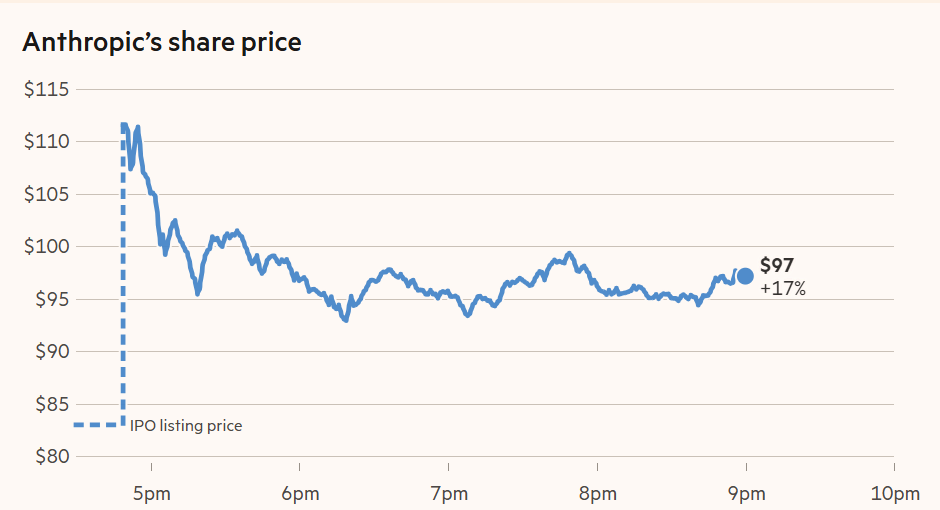
Anthropic popped 17 per cent to close at about $97 a share in its Wall Street debut after raising $81bn in the biggest-ever initial public offering as investors clamoured for equity in the company at the centre of the AI boom.
The Claude AI maker’s stock had earlier on Thursday soared as much as 39 per cent over its listing price of $83 a share, which had already been boosted over the initial target of $78. Anthropic sold 980mn shares on Wednesday night, far more than originally planned.
The nearly six-year-old AI lab secured a market value of $1.3tn, or $1.75tn fully diluted, at Thursday’s closing price, putting it into the elite club of companies valued above $1tn but lower than SpaceX’s valuation at the end of its first day.
Its offering met huge demand, with around half of institutional accounts receiving no shares while retail investors were allocated a lower-than-expected 15 per cent. The debut triggered furious trading, with $86bn worth of shares changing hands.
Chief executive Dario Amodei rang the Nasdaq bell alongside his sister and co-founder Daniela, pledging “we will not bend to either business or political pressure”, despite protests outside the building in New York.
Having filed its paperwork in June, Anthropic held off its IPO until what bankers viewed as the last viable week to list before the US holiday season, raising the tension around investor demand for the first pure-play model maker to come to public markets.
The Nasdaq 100 has slipped 7 per cent in the past six months as analysts worry the stock market and financing boom built around AI is overstretched. The tech-heavy index closed just over 2 per cent lower on Thursday.
The successful listing caps an extraordinary year for Anthropic, during which it raced past arch-rival OpenAI to produce the most capable AI models and beat Sam Altman’s start-up to the public markets.
Scores of Anthropic employees will become millionaires thanks to the listing, which gives each of its co-founders a paper fortune of more than $20bn and also hands multibillion-dollar gains to a wide range of early investors. Google and Amazon will be among its largest shareholders, having recouped their investments several times over.
Goldman Sachs and Morgan Stanley, the lead underwriters, will collect a combined 41 per cent of the wider $550mn banking fee pool, with the two banks each taking more than $110mn.
Some jilted investors complained about the slim pickings, with one calling the allocation process “a joke”.
The $81bn capital raising, alongside a $26bn private placement led by its main hardware and data centre providers, including Nvidia, Microsoft and Google, bested SpaceX’s IPO in June and leaves Anthropic with about $230bn in cash.
The fundraising haul could rise if underwriters exercise a so-called greenshoe option to sell additional shares.Amodei said the IPO would put Anthropic in a “stronger financial position”, which “strengthens our resolve to do the right thing”.
Anthropic will be able to deploy its huge cash war chest to lock in the vast amounts of computing power it needs to train and run its models. It has outlined plans to spend $900bn on computing infrastructure between now and 2045.

The company, last valued at $965bn in a private financing in May, has indicated the IPO is probably its last equity raising for the foreseeable future, given its progress towards profitability and greater access to debt as a public company.
Formed by seven former OpenAI staffers who grew disillusioned with Altman’s leadership, Anthropic is still a public benefit corporation with a mission to ensure responsible AI development benefits humanity. It warned potential shareholders not to view their investment in “purely transactional terms”.
Amodei has expounded the potentially transformational benefit of AI, including huge productivity gains and cures for disease.
It has gone public with a complex and unusual governance structure that gives ordinary investors almost no say in corporate decisions, with power broadly split between its seven co-founders and a long-term benefit trust intended to steward its mission.
Amodei has repeatedly warned that its models could also pose “catastrophic or existential risks to humanity”, ranging from helping bad actors create chemical weapons to enabling hacking or superintelligent AI running out of human control.“
The most difficult safety work lies ahead of us,” Amodei said on Thursday. “To state it unequivocally: we will pace the training deployment of AI systems, taking as long as is necessary to have confidence” that they are safe.
Additional reporting by Akila Quinio
