









Bank of England raises interest rates to 4% in bid to tame inflation
Governor Andrew Bailey signals further rate rise to come as projections show increasing price pressures



Not to be redistributed, copied or modified in anyway. FT and Financial Times are trademarks of the Financial Times Limited.
Chip has hosting rights to certain limited Financial Times articles. This is not a live feed of Financial Times content.
All commentary and opinions are those of independent FT journalists and experts, not those of Chip. Chip does not give financial advice.
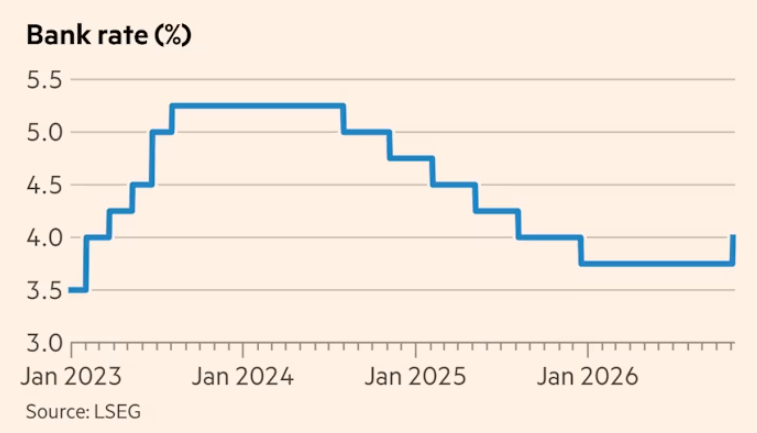
The Bank of England has raised rates by a quarter point to 4 per cent and signalled it is planning at least one further increase as soon as next month, as it warned inflation will hit 5 per cent next year.
Thursday’s rate increase from the Monetary Policy Committee was its first since 2023 and comes as the energy shock unleashed by the Iran war has prompted a string of central banks to lift borrowing costs.
In a sign of the PC’s concern over inflation, eight members backed the quarter-point rise, with Catherine Mann breaking ranks to vote for a half-point increase
A new set of forecasts released by the BoE on Thursday pointed to building price pressures, with the central bank raising its inflation forecast to 4.5 per cent in the first quarter of next year.
It said inflation would hit 5 per cent in the second quarter and, under its central projection, not return to the BoE’s 2 per cent target until the third quarter of 2028.BoE governor Andrew Bailey said the “inflationary pressure in the pipeline” was sufficient to warrant a rate rise now, with a further increase likely as soon as December.
“Today’s increase shouldn’t be seen as the first in an inevitable long sequence of hikes,” he said. “But unless the conflict in the Middle East is resolved, neither does it seem to be the last increase.”
The MPC has for months been split over whether soaring energy costs will lead to broader and more prolonged price pressures across the economy.
In an indication of the uncertainty over the inflation outlook, oil prices have slumped this week as hopes of an end to the conflict in the Middle East have increased.
The fall became more pronounced when Democrats swept to victory in Tuesday’s US midterm elections.
Bailey said that while the decline in oil and gas prices this week was “positive news”, there were already “significant” inflationary pressures in the system, including an expected increase in household energy bills from January.
The bank said that while “a credible and sustained de-escalation of the conflict” could prompt a fall in price pressures, any wider regional escalation or damage to refining capacity “could lead to persistently higher prices”.
Following Thursday’s decision, traders put the chance of a quarter-point rise at the MPC’s December meeting at 55 per cent, up from roughly 20 per cent.The pound rallied slightly, erasing its earlier losses to trade slightly higher against the dollar by the afternoon at $1.348.
Matt Amis, an investment director at Aberdeen Investments, said: “The takeaway from today is that we should expect another quarter-point rate rise, and whether it comes in December or February is dependent on energy prices.”
Relatively resilient growth has helped support the case for rate rises, with the BoE now projecting growth of 1.6 per cent this year and 1.3 per cent in 2027.