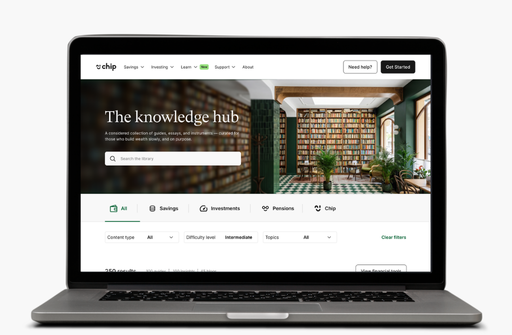
The knowledge hub

A considered collection of guides, essays, and instruments — curated for those who build wealth slowly, and on purpose.

0
results
Filter results
Filter by:
Content type
Difficulty level
Topics
0
results
View financial tools
Investing: Why you should ignore the ghost stories
2 min read
Beginner
Investing strategies

The word investing can send a chill down some people’s spines.

Terms like “volatility” and “risk” can sound straight out of a horror film. And ‘losing all your money’ well that’s the stuff of nightmares.

But here’s the truth: investing doesn’t have to be scary. In fact, once you understand it, it’s far less Freddy Krueger and much more Casper the friendly ghost.

Let’s (ghost)bust a few myths and show you how Chip helps keep your money safe from what’s lurking in the shadows.

Myth 1. “I could lose everything!?”

This is the classic jump scare. But barring something like a zombie apocalypse, it's almost impossible. 

Yes, markets go up and down, that’s part of the story. 

But when you invest through Chip, your money is spread across hundreds (sometimes thousands) of companies, sectors, and regions. So even if one part of your portfolio takes a fright, others can help you get through the night.

And if we do have a ‘28 Days Later’ scenario, then I think we all have bigger problems than the stock market.

Myth 2. “I need to be an expert”

You don’t need to be a mysterious, all-knowing spectre hiding in a candlelit library to invest. With Chip, you can start from as little as £1, choose from clear, ready-made investment funds that are good to go.

The hard work is done for you, partnering with (real) experts who manage your investments funds for a low-transparent fee, so you can focus on growing your money without wondering what’s hiding under the bed.

Simple, smart, and built for everyone – not just the wizards of Wall Street.

Myth 3: “Now’s not the right time.”

Trying to time the market perfectly is like trying to cheat death in Final Destination – it’s highly unlikely to happen

Markets move, the news cycle changes, and there’s always a new headline to worry about. But history shows that staying invested, rather than trying to time it, is how you survive the scary bits and see the best long-term results.

If you’re nervous, try easing in with pound-cost averaging: investing small amounts regularly, so you smooth out the ups and downs over time. It’s a calm, steady way to build your confidence - and your wealth.

Myth 4: “You need loads of money to get started.”

This one is another work of fiction – like a 104-year-old vampire who decides to use his immortality to endlessly repeat high school.

In fact, getting started early (even with small amounts) can make a huge difference thanks to the magic of compounding; where your returns start earning returns of their own.

At Chip, you can begin with just £1 and build from there. No big commitment, no minimums — just a realistic, approachable way to put your money to work.

So this Halloween…

Don’t let the fear of the unknown and old ghost stories stop you from getting started with investing.

And as an added bonus, start now and pay 0% platform fees* until 31 January 2027. Eligibility & T&Cs apply.

With Chip on your side, a clear plan, and a little guidance, investing isn’t a horror story — it’s just another way to grow your money.

* Fund management charges apply.

Fintech & the future of investing
2 min read
Expert
Investing trends

What is Fintech?

Fintech, short for "financial technology", refers to the innovative use of technology to deliver financial services in faster, more efficient, and user-friendly ways. 

Whether it's making a payment through your smartphone, automating savings, or accessing investment platforms online, fintech is reshaping how people interact with money.

Its rapid growth has significantly influenced personal finance, banking, and investing, particularly for beginner investors.

How fintech has changed the landscape

Technology has disrupted traditional finance models in a number of ways:

  • Open Banking: This allows licensed fintech firms to securely access financial data (with user permission) from major banks. It encourages competition and enables tailored tools for budgeting, saving, and investing.
  • Cryptocurrencies: Although high-risk and highly volatile, crypto assets have become part of the broader investing conversation, particularly among younger investors.
  • Robo-Advisors: These algorithm-driven tools automate investment decisions based on a user’s goals, risk appetite, and time horizon, reducing the need for human financial advisors.
  • AI and Data Analytics: Artificial intelligence is powering smarter tools for portfolio management, financial planning, and fraud detection. It's also enabling more personalised investment recommendations at scale.
  • Fractional Shares: Enabled by tech platforms, fractional shares allow users to invest in portions of high-priced assets — making investing more affordable and inclusive.

Are fintech companies making investing more accessible?

Fintech companies have had a huge impact on the world of investing. Previously, the entry into investing was a lot higher and more complicated. Fintechs have changed this, such as:

  • Lower Barriers to Entry: Features like fractional shares allow users to start investing with just a few pounds, without needing to buy whole stocks.
  • User-Friendly Interfaces: Many platforms are designed for beginners, offering clear explanations, educational content, and intuitive dashboards.
  • Low/No Minimum Balances: Traditional investing sometimes requires large upfront deposits. Fintech platforms often remove or reduce these requirements.
  • Mobile Access: The ability to manage investments from a smartphone increases access for users who may not live near a traditional financial institution.

Fintech and the future of banking

Fintech isn't just a supplement to traditional banking, it's increasingly becoming an alternative. As digital-native generations demand faster, personalised services, banks are being challenged to innovate or collaborate with fintech providers.

Expect continued growth in features like:

  • Seamless investing integrated within digital banking apps
  • Predictive financial planning using AI
  • More flexible, modular financial products

How are fintechs funded?

Fintech companies often rely on a mix of:

  • Venture Capital (VC): Private investors backing early-stage innovation
  • Crowdfunding: Where everyday users can invest in the company itself
  • Revenue-Based Models: Fees from premium features, subscriptions, or commissions
  • Institutional Investment: From traditional financial players seeking digital exposure

The funding model can impact how a platform grows and the types of services it prioritises.

Do people trust fintech over high street banks?

Consumer trust in fintech is growing, particularly among younger users. While traditional banks benefit from longstanding reputations, fintech platforms offer speed, innovation, and often better user experiences.

However, trust varies depending on:

  • Security protocols
  • Transparency in pricing
  • Customer service quality
  • Regulatory compliance

Surveys show that while many users are open to fintech solutions, trust often increases once users try the service and experience its benefits.

How are fintech companies regulated?

In the UK, fintech companies must be authorised and regulated by the Financial Conduct Authority (FCA). This includes:

  • Ensuring platforms act in the best interests of customers
  • Meeting capital requirements to remain solvent
  • Protecting user data and funds
  • Operating with transparency and fairness

Users can check the FCA Register to verify if a company is properly authorised. Regulation is especially important in protecting users in cases of fraud, poor financial advice, or platform failure.

Fintech summary

Fintech is reshaping the way people in the UK approach investing. From fractional shares to automated tools, it’s lowering barriers and offering more people a path toward building wealth. 

However, it's important to understand how these platforms are regulated, funded, and trusted before diving in.

At the start of your investing journey, you’ll need to decide if you want to take an active or passive approach to your investments.

In the next guide in this Investment Strategies series, we’ll cover the difference between these two strategies.

What is diversification?
2 min read
Beginner
Portfolio building

Understanding the importance of diversification

Markets can move unpredictably. One asset class might be soaring while another is falling. Diversification ensures you’re not overly reliant on a single investment or sector to meet your financial goals.

For example, if your portfolio is made up entirely of tech stocks, a downturn in the tech industry could cause a sharp drop in your portfolio. But if you also own bonds, commodities, and shares in other industries, those assets may hold steady or even rise, helping cushion the blow.

Diversification doesn’t guarantee profits, but it can make the investing journey less bumpy by balancing the ups and downs.

Diversification strategies in investing

There are many ways to diversify a portfolio. Investors often combine several of the following approaches:

  • Asset classes: such as stocks, bonds, real estate, commodities, or cash equivalents.
  • Industries and sectors: spreading across technology, healthcare, finance, consumer goods, and more.
  • Market capitalisations: investing in both large, stable companies (blue chips) and smaller, growth-focused firms.
  • Risk profiles: mixing higher-risk, higher-return assets with safer, lower-yield options.
  • Tangibility: balancing between traditional financial assets and physical assets like property or gold.

The right mix depends on your goals, time horizon, and risk tolerance.

Advantages of diversification

  • Could reduce the risk of heavy losses from one sector.
  • Could provide protection against market fluctuations.
  • Could help investors achieve steadier long-term growth. 
  • Offers exposure to different markets and opportunities. 

Disadvantages of diversification
  • Can limit short-term gains if one area performs very well.
  • More complex and time-consuming to manage.
  • May involve higher costs or fees, especially if spread out across platforms. 
  • Can feel overwhelming for new investors looking for a simpler approach. 

How to assess portfolio diversification

Holding several different investments doesn’t guarantee your portfolio is diverse, the weighting of each investment matters too.

For example, holding ten different stocks might look diverse, but if they’re all in the same industry, you’re still exposed to the same risks.

One way to assess diversification is by looking at how much of your portfolio is concentrated in one asset class, sector, or company. Tools and portfolio trackers can help you see where your money is spread and identify any gaps or imbalances.

See our full guide on portfolio management.

Diversification summary

Diversification is one of the simplest yet most effective ways to manage risk in investing. By spreading your money across different asset types, industries, and markets, you can give yourself a smoother journey towards your long-term goals.

Next in this series: How to rebalance your portfolio, why it matters and how to adjust your investments to stay on track.

What are gold and commodities?
2 min read
Intermediate
Asset classes

Why do people invest in gold?

Gold has held its appeal for thousands of years and for good reason. It’s often viewed as a safe haven1 (prices can fluctuate) investment that people turn to during periods of uncertainty.

Here’s why it continues to attract attention from investors:

  • Store of value: In times of economic crisis or market downturns, gold tends to retain its worth better than riskier assets.
  • Hedge against inflation: When inflation rises and currency loses purchasing power, gold has historically maintained or increased its value – acting as a financial hedge.2
  • Diversification: Gold doesn’t typically move in the same direction as stocks or bonds, making it a useful addition to a balanced portfolio.

1Investopedia

2Investopedia

How to invest in gold in the UK

There are several ways to gain exposure to gold, depending on your preferences, budget, and investment goals:

1. Physical gold
  • Pros: Tangible, recognised globally, no counterparty risk (the chance that a party to a financial transaction, like a loan, investment, or trade, will fail to fulfill its obligations, potentially leading to losses).
  • Cons: Needs safe storage, insurance, can be less liquid than other options.
2. Gold ETFs, Gold ETCs and funds
  • Pros: Simple, cost-effective, easy to buy/sell like stocks.
  • Cons: Doesn’t give you access to physical gold. May involve price tracking errors or management fees.
3. Gold mining stocks
  • Pros: Potential for higher returns if gold prices rise.
  • Cons: Company-specific and operational risks. 
4. Gold savings accounts or digital vaults
  • Pros: Fractional ownership (an option to share between a number of investors), digital ease, lower entry point.
  • Cons: May have account or withdrawal fees, and depends on provider trustworthiness.

Risks and disadvantages of investing in gold 

Like any asset, gold has its downsides. It’s important to understand these before diving in:

  • No income: Gold doesn’t pay dividends or interest – returns are confined to price growth (may be subject to Capital Gains tax).

  • Price volatility: Despite its ‘safe haven’ label, gold can still fluctuate in value based on market sentiment, interest rates, or geopolitical news.

  • Storage and insurance costs: Holding physical gold securely often comes with extra fees and responsibilities.

Historical performance of gold

Gold has historically provided moderate long-term returns, though it can go through extended periods of underperformance. Over the past 20 years, gold has returned an average of ~12% per year.1

It has historically performed best during:

  • Inflationary periods
  • Currency devaluations
  • Market shocks or crises

1 J.P. Morgan

Investing in other precious metals and commodities

Gold isn’t the only option when it comes to tangible assets. Other precious and industrial commodities can also play a role in your strategy.

Precious metals:
  • Silver – More volatile than gold, with both monetary and industrial demand.
  • Platinum & palladium – Used in manufacturing and clean energy tech, offering unique demand drivers.
Broader commodities:
  • Oil & natural gas – Linked to global energy prices. Prone to sharp swings but still essential to global economies.
  • Agricultural commodities – Wheat, coffee, sugar, and livestock can offer growth tied to global supply/demand shifts.

These can help hedge against inflation or add exposure to global growth – but also carry distinct risks based on weather, politics, or regulation.

How to invest in commodities in the UK

You don’t need to stockpile barrels of oil or coffee beans to invest in commodities. Here are some beginner-friendly ways to get started:

  • Commodity ETFs/ETCs – Track the price of specific goods or baskets of commodities (e.g., gold, oil, agriculture).
  • Futures contracts – More advanced and high risk – these involve speculating on the future price of a commodity.
  • Commodity-producing companies – Invest in miners, energy producers, or agricultural businesses.
  • Physical metals – As mentioned, physical gold or silver remains popular for tangibility and trust.

Gold and commodities in a diversified portfolio

Commodities behave differently than traditional assets like stocks and bonds – so they can add balance to your portfolio.

They’re often non-correlated, meaning they may rise when stocks fall (especially during inflation, currency shocks, or geopolitical events).

Investing in gold and commodities summary

Gold and other commodities can be powerful tools for diversification, especially in uncertain economic times.

They don’t generate income like stocks or bonds, but they can help protect against inflation, currency weakness, or financial market shocks.

The right amount for your portfolio depends on your goals, risk tolerance, and time horizon. However, even a small allocation can go a long way in building resilience.

In the next guide of the series we take a closer look at cryptocurrencies and how they work. 

FAQs
How can a beginner invest in gold?

ETCs, ETFs and other digital options can be great starting points due to their accessibility, low cost, and simplicity.

How do you invest in gold in the UK?

Options include buying physical gold (bars, coins), investing via ETCs, ETFs or funds, purchasing mining stocks, or using digital vault platforms.

Is gold the best investment?

Gold is a defensive asset so it can protect against market shocks. Best used as part of a wider, diversified portfolio.

What’s the difference between investing in gold and silver?

Gold is more stable and seen as a store of value. Silver has greater industrial use, tends to be more volatile, but can offer higher returns under certain conditions.

Direct investment into gold and commodities is not available via the Chip platform.

What's my replaceable ISA allowance?
2 min read
Savings Strategies & Tips

ISAs are the most popular savings product in the UK, but they aren’t always the easiest to understand if you aren’t familiar with the ins and outs.

Some Cash ISAs are flexible. That means if you take money out, you can put it back in again within the same tax year, without using up any of your annual £20,000 ISA allowance.

But your ‘replaceable ISA allowance’ goes beyond that.

This is the extra "capacity" created when you withdraw money from a previous tax year. Instead of losing that tax-free space forever, you get a temporary window to put that exact amount back in without it counting as a new contribution.

The previous tax year rules

If you have a large balance built up over several years, a Flexible ISA allows you to treat that "old" money with the same freedom as your current £20,000 allowance.

You can withdraw "old" money: Let’s say you have £50,000 from previous years, you can withdraw any amount of it, e.g. £30,000, and your "replaceable allowance" for the year effectively becomes £50,000 (£20,000 current limit + £30,000 old money).

The "same account" restriction: While you can pay current year replacements into different ISAs, you must pay previous year replacements back into the exact same account they were taken from.

The "use it or lose it" deadline: Regardless of how old the money was, the "flexible window" always slams shut on 5 April. If you withdraw £30,000 of old money in August 2025, you have until midnight on 5 April 2026 to replace it. If you miss that date, that £30,000 of "tax-free capacity" is gone forever.

How the flexible money goes back in (the order)

HMRC has a "filling up" order for when you pay money back into a flexible ISA so you always know how its affecting you

  1. Replenish previous years first: Your deposits first "fill back up" any money you took out from previous years.
  2. Replenish current year next: Once old money is replaced, your deposits then cover any current-year withdrawals.
  3. New subscriptions last: Only after all withdrawals are replaced do your deposits start counting toward your fresh £20,000 annual limit.

Why it can supercharge your tax-free savings

A replaceable ISA allowance gives you flexibility that many people don't realise they have.

In practice, this means you can pay in more than £20,000 in a single year, as long as part of that amount is replacing money you previously took out.

That flexibility makes your ISA a more adaptable tool for real life. You can use it for short-term needs, like a house deposit, home improvements, or a major life event, and still keep your long-term plans intact.

It can also be particularly useful if you have already used your £20,000 allowance for new money elsewhere and did not realise (or forgot) you still had the option to replace earlier withdrawals.

The key is knowing the allowance is there, and making use of it within the same tax year if it fits your situation.

Passive and active investing explained
2 min read
Beginner
Investing strategies

What is passive investing?

Passive investing is a long-term investment strategy that aims to replicate the performance of a market index, rather than trying to beat it.

Investors typically buy into funds, such as index funds or exchange-traded funds (ETFs), that track a broad market benchmark like the FTSE 100 or S&P 500.

Key passive investing characteristics
  • Low cost: Passive funds generally have lower fees because they require minimal management. 
  • Buy-and-hold approach: Passive investors aim to ride out market ups and downs over time. 
  • Diversification: Tracking an index provides exposure to a wide range of companies.

What is active investing?

Active investing involves ongoing decision-making to buy, hold, or sell assets in an attempt to outperform the market. 

This strategy is often managed by fund managers or individual investors who analyse market trends, company performance, and economic indicators to make investment choices.

Key active investing characteristics
  • Higher costs: Fund management, research, and transaction fees tend to be higher. Learn about investment fees and costs.
  • Tactical decisions: Active managers may buy or sell holdings frequently to exploit market opportunities.
  • Potential for higher returns: Success depends on skill, timing, and market conditions.

The advantages and disadvantages of passive investing

Advantages of passive investing include:
  • Lower fees: Less management means reduced ongoing costs.
  • Simplicity: Ideal for beginners; less time and knowledge required.
  • Market-matching performance: Often performs better than many actively managed funds over the long term.
Disadvantages of passive investing include:
  • No chance to outperform the market: Returns will always closely mirror the index.
  • Limited flexibility: Can’t adjust quickly to market shifts or exploit short-term opportunities.
  • Market downturns: Passive funds track indexes even during declines, with no defensive measures in place.

The advantages and disadvantages of active investing

Advantages of active investing include:
  • Opportunity for higher returns: Skilled asset managers can outperform the market, especially in less efficient markets.
  • Flexibility: Managers can pivot strategies in response to changing conditions.
  • Tailored investment strategies: Portfolios can be aligned with specific goals or themes (e.g., ethical investing, emerging markets).
Disadvantages of active investing include:
  • Higher costs: Active funds charge more, which can eat into returns.
  • Greater risk of underperformance: Many active funds fail to beat their benchmarks after fees.
  • Requires more research and monitoring: Not ideal for novice investors or those short on time.

Is active or passive investing right for me?

Choosing between active and passive investing depends on your goals, how much time you want to dedicate to managing your investments, and how comfortable you are with risk. How to know your risk tolerance.

If you're just starting out, passive investing is often a practical and beginner-friendly option. It requires little ongoing effort, keeps costs low, and provides broad exposure to the market.

It’s especially suited to long-term investors who prefer a “set it and forget it” approach and are happy with market-average returns.

On the other hand, if you're someone who enjoys researching companies, keeping up with economic trends, and believes in your ability (or that of a professional) to spot investment opportunities, active investing might appeal to you. 

It offers the potential for higher returns but comes with more risk, higher fees, and a greater time commitment.

You should also consider your risk tolerance. Passive investing tends to be more stable and predictable, while active investing can be more volatile, especially over shorter periods.

Importantly, you don’t have to choose one or the other. Many investors find that a blend of both, using passive strategies for long-term stability and active ones for targeted opportunities, gives them the best of both worlds.

How to combine active and passive investing

Many investors choose a blended approach, combining both active and passive strategies to balance cost, control, and opportunity.

Common combinations:

  • Core and satellite: Use a passive fund for the core of your portfolio, with smaller “satellite” allocations to active funds targeting specific sectors or regions.
  • Thematic investing: Stick with passive index funds for broad market exposure and add active investments in areas you believe have strong growth potential.
  • Rebalancing over time: Start passive, then explore active strategies as your confidence and knowledge grow.

This approach allows flexibility while keeping fees manageable and risk diversified.

Passive and active investing summary

Understanding the core differences between passive and active investing is essential for building a strategy that suits your financial goals and comfort level. 

While passive investing offers cost-efficiency and simplicity, active investing presents opportunities for higher returns, albeit with added risk and effort.

Ultimately, there's no one-size-fits-all answer. Many UK investors successfully use a mix of both approaches to suit their needs.

In the next guide in our Investment Strategies series, we’ll explore another foundational concept: Growth Investing vs Value Investing, two popular approaches to selecting individual stocks.

What is an instant access account?
2 min read
Beginner
Accounts & Products

An Instant Access Account is a type of savings account that allows you to deposit and withdraw your money whenever you need it, without incurring any penalty charges. 

It is an easy-to-use and flexible savings option that generally offers a higher interest rate than a standard current account.

In the UK, Instant Access Accounts are offered by various banks, building societies and other financial providers. They can be opened online, over the phone or in person at a branch (depending on the provider).

What are the benefits of an instant access Account?

1) Flexibility

One of the main benefits of an Instant Access Account is its flexibility. 

You can deposit or withdraw money from the account whenever you need it, usually without any restrictions or penalties. This makes it a great option for those who need easy access to their savings.

2) Competitive interest rates

Instant Access Accounts usually offer a higher interest rate than standard current accounts, which means you can earn more money on your savings.

However, the interest rate is generally lower than fixed-term savings accounts, which require you to lock your money away for a set period of time. Different types of savings accounts.

3) No penalties

Unlike some other savings accounts, there are usually no penalties for withdrawing money from an Instant Access Account. You can usually make as many withdrawals as you like, without incurring any charges. 

This does, however, depend on the savings account provider and their terms and conditions of the account. 

4) Protection

Your savings in an Instant Access Account are protected by the Financial Services Compensation Scheme (FSCS), which means that if the bank or building society held in the UK goes bust, you will be protected up to £120,000 per person, per institution. 

Please note that FSCS is subject to eligibility and limits apply. For more information, please visit: https://www.fscs.org.uk/check/ 

How to choose the right Instant Access Account?

When choosing an Instant Access Account, it’s important to compare the interest rates offered by different banks and building societies.

You should also consider any additional features, such as charges that may or may not apply.

It’s also important to check whether the bank or building society is covered by the Financial Services Compensation Scheme, which provides protection for your savings in the event of the institution going bust.

Instant Access Account Summary

In conclusion, an Instant Access Account is a flexible and convenient savings option that offers competitive interest rates and easy access to your funds.

It’s a great choice for those who need to save money but also need access to their funds whenever they need it. 

By choosing the right Instant Access Account, you can make your money work harder for you, while also enjoying the peace of mind that comes with knowing your savings are protected under FSCS (subject to eligibility)

Remember to always do your research when comparing instant access accounts and that you’re fully aware of any terms of conditions when opening an account with a provider.

What is asset allocation and why is it important?
2 min read
Intermediate
Portfolio building

What is asset allocation?

Asset allocation is how you divide your investments between different asset types like stocks, bonds, property, and cash, to help achieve your financial goals. 

Each asset type behaves differently, and the right mix can help balance growth potential with risk.

Why is asset allocation important?

Asset allocation is important to ensure your investments match your goals and risk tolerance. Rather than randomly picking investments, it’s about choosing the right balance of assets to suit you.

Different assets respond differently to market conditions. For example, when stocks fall, bonds might hold steady or even rise. By blending asset classes, you reduce the impact of any single investment performing badly.

Without asset allocation, your portfolio could end up being too risky (or too cautious) without you realising it. A deliberate mix helps keep you on track towards your goals while managing the bumps along the way.

See our full guide on risk, returns, and investment strategies.

Maximising return whilst minimising risk

Every investor wants good returns, but chasing the highest potential gains often means taking on more risk. Asset allocation helps you find the sweet spot between risk and reward that works for you.

For example:

  • Stocks tend to have higher long-term returns but more short-term volatility.
  • Bonds generally offer lower, steadier returns and act as a stabiliser during downturns.
  • Cash equivalents are the safest, but have minimal growth potential.

By combining these assets in the right proportions for your goals, you can aim for growth while potentially cushioning against big losses. If you need the money in the short term, you might lean towards safer assets; if you’re investing for decades, you could afford to take more risk for potentially higher returns.

See our full guide on investment types and asset classes.

Conservative portfolio vs aggressive portfolio

Two investors can have completely different asset allocations depending on their risk tolerance and objectives. For example:

  • Conservative portfolio: Might hold 70% bonds, 20% stocks, 10% cash. Lower volatility, smaller potential gains, more focus on preserving capital.
  • Aggressive portfolio: Could be 80% stocks, 15% bonds, 5% cash. Higher volatility, greater potential returns over the long term, more tolerance for short-term dips.

Your portfolio can sit anywhere along this spectrum, and it can evolve as your circumstances change.

See our full guide on defensive and aggressive investing.

What is age-based asset allocation?

Age-based asset allocation is a simple strategy that adjusts your mix of assets as you get older. The idea is to keep a higher risk profile when you’re younger and gradually reduce it as you near your financial goals. 

A common rule of thumb suggests subtracting your age from 100 or 120 to find the percentage of your portfolio to invest in stocks.1 For example:

  • If you’re 30: 100 − 30 = 70% stocks, with the rest in bonds and cash.
  • If you’re 60: 100 − 60 = 40% stocks, with a larger portion in lower-risk assets.

It’s not a one-size-fits-all formula, but it’s a useful starting point for thinking about how risk profiles might change over time.

See our full guide on retirement and long-term investing

1Morningstar

How to rebalance your portfolio

Over time, market movements can shift your asset allocation away from your original target. For example, if stocks perform well, they might make up a larger share of your portfolio than planned, which could mean more risk than you intended.

Rebalancing means selling some of the assets that have grown too much and buying more of the ones that have lagged, to restore your desired allocation. Many investors review and rebalance their portfolios once or twice a year.

Making small, purposeful changes can help to keep you moving towards your goal.

Asset allocation summary

Asset allocation is the foundation of a sound investing strategy, helping you balance risk and reward through the right mix of asset classes. Your allocation should reflect your goals, risk tolerance, and time horizon, and it’s worth adjusting it as your life and the markets change.

Next in this series: The importance of diversification, how spreading your investments further within asset classes can strengthen your portfolio.

How much do I need to retire?
2 min read
Intermediate
Building your pension

What is a good pension pot? 

A ‘good’ pension pot is one that generates enough income for you to cover your expenses during retirement. As life expectancy increases, so does the necessity for a larger pension pot.

To work this out, you need to think about annual expenses, not just a total lump sum. We’ll use a defined contribution pension pot as an example, as defined benefit schemes offer a largely guaranteed income.

  • The 4% rule: The 4% rule: A helpful, if not failsafe, rule of thumb for calculating sustainable income. Withdrawing 4% of your total pot in year one, then adjusting for inflation each year, has historically given a strong chance of your money lasting 30 years — though some advisers recommend a more conservative rate of 3–3.5%.
  • An example calculation: To get an income of £20,000 from your private savings (on top of the State Pension) you’d need a pot of roughly £500,000. 

How much should I have in my pension? 

While everyone’s journey to retirement is different, there are some rough age-based benchmarks to help check if you’re on the right track.

  • At 30 you should aim to have saved your current annual salary, once. For example, if you earn £30,000, you should have £30,000 in pension savings.
  • At 40 you should aim to have saved three times your annual salary. For example, if you earn £30,000, you should have £90,000 in pension savings.
  • At 50 you should aim to have saved six times your annual salary. For example, if you earn £30,000, you should have £180,000 in pension savings.

These are great scenarios but if you are behind where you need to be, don’t panic — saving for retirement is a marathon, not a sprint. You can catch up by increasing your contributions later in your career.

Retirement Living Standards (PLSA) 

The Pensions and Lifetime Savings Association (PLSA) publishes the Retirement Living Standards.

These act as a practical guide to help you understand how much income you might need to achieve different standards of living in retirement (calculated after income tax).

These figures are updated for the 2025/26 Tax Year and assume you will be mortgage-free by the time you retire.

The Minimum Lifestyle
  • Cost: £13,900 (one-person) | £22,500 (two-person)
  • What it covers: All your basic, essential needs with a little left over for fun. It includes a UK holiday (self-catering or half-board), one meal out per month, and affordable weekly leisure activities, but no car.
  • Amount needed: For a two-person household, two full State Pensions combined usually cover this standard. A one-person household will generally need a small private pension pot to top up the State Pension and bridge the gap.
The Moderate Lifestyle
  • Cost: £32,700 (one-person) | £45,400 (two-person)
  • What it covers: Increased financial security and more flexibility. You can run a small car (replaced every 7 years), take an annual 2-week overseas holiday alongside a UK long weekend break, and enjoy eating out or ordering takeaways a few times a month.
  • Amount needed: A one-person household would typically need the full State Pension supplemented by a private pension pot of roughly £335,000 to £505,000.
The Comfortable Lifestyle
  • Cost: £45,400 (one-person) | £62,700 (two-person)
  • What it covers: More financial freedom, spontaneity, and some luxuries. You can replace a small car every 5 years, enjoy regular theatre trips or day outings, take a 2-week foreign holiday (up to 4-star), and enjoy up to three UK long weekend breaks every year.
  • Amount needed: A one-person household would typically need the full State Pension supplemented by a private pension pot of roughly £560,000 to £845,000.

What is my retirement age? 

There are two key ages to know when it comes to accessing your pension pots. You can of course choose to stop working earlier, but only if you have enough savings to fund your lifestyle without drawing on these pots.

Outside this scenario, these are:

  • State Pension Age: This is when the government starts paying you. Currently, it is 66, rising to 67 between 2026 and 2028. Read our full guide on the State Pension.
  • Normal Minimum Pension Age (NMPA): This is the earliest you can usually access your private or workplace pension. Currently, it is 55, but it will rise to 57 on 6 April 2028.

Note: If you were a member of a pension scheme before 3 November 2021, you may have a 'protected pension age' — meaning you could still access that pension from age 55, even after the 2028 change. This applies at scheme level, so it's worth checking each pension you hold individually, as the protection may not apply to all of them. 

Read our full guide on retirement ages.

Pension contributions

Once you’ve worked out how much you need to retire, the next step is working out how to get there.

Hitting a £500,000 target might sound impossible if you just look at your salary, but you don’t have to do it alone.

Between tax relief and employer contributions, the amount landing in your pot can be significantly more than what you actually pay from your salary or savings.

In our next guide, we break down exactly how these contributions work and the ‘golden rule’ for how much you should be contributing based on your age.

Thank you! Your submission has been received!
Oops! Something went wrong while submitting the form.