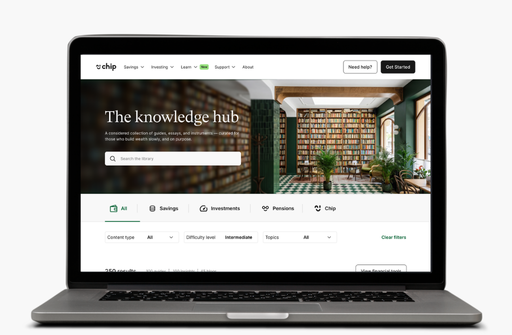
The knowledge hub

A considered collection of guides, essays, and instruments — curated for those who build wealth slowly, and on purpose.

0
results
View tools
Filter results
Filter by:
Content type
Difficulty level
Topics
0
results
View financial tools

Pension funds

2 min read
Intermediate
Building your pension

What is a pension fund? 

A pension fund is a large pot of money pooled together from many different pension savers. Professional fund managers use this pool to buy a diverse range of assets within their pension plans, such as:

  • Shares: (equities): Owning small parts of companies (e.g. Apple, Shell, Tesco). Historically, these offer high growth but come with higher volatility. 
  • Bonds: Loaning money to governments or corporations in exchange for interest. These are generally safer/lower risk but offer lower returns.
  • Property: Commercial real estate like warehouses and office blocks.

By investing in a fund, you don’t choose specific investments yourself. The aim of holding a fund is to spread your risk over hundreds or even thousands of assets, to smooth out the ups and downs of the market.

What is a target date fund? 

A target date fund (TDF) is a type of pension fund designed to make retirement planning simple and automatic.

Instead of asking you to choose a level of risk when you start pension saving, you simply enter the year you plan to retire.

  • In the early years (when retirement is far away) the fund automatically invests mostly in shares to maximise growth. You can afford to take risks because you have time to recover from market dips.
  • In the later years (as you approach retirement) the fund gradually shifts your money into safer assets like bonds. This protects your pot from volatility as you get closer to needing the money.

The ‘glide path’ approach removes the need for you to constantly monitor and rebalance your portfolio, as the fund does this for you.

Choosing a pension fund 

If you are managing your own pension (like in a SIPP) or looking at your workplace options, choosing the ‘right’ fund depends on your timeline.

  • Timeframe: If you have 30+ years until retirement, inflation could erode the returns from lower risk assets, so some exposure to shares can help beat rising prices. If you’re retiring next year, you’ll likely want the safety from cash or bonds. 
  • Risk tolerance: Think about the risk you’re comfortable with. Can you handle watching some ups and downs as the market moves? If not, a lower-risk fund might be better suited to you, even if returns are lower.

What is a default pension fund?

A default pension fund is the investment option you’re automatically allocated when you join a workplace pension scheme. It’s a ‘one-size-fits-all’ solution for the average employee.

While default funds are regulated to be suitable for most people, they are not tailored to your specific circumstances or retirement savings trajectory.

They typically take a balanced approach that’s potentially too cautious for the younger saver or too risky for someone closer to retirement.

Some default funds use a target date approach and adjust automatically, check whether yours does. 

How to check your pension fund  

To check which pension fund you’re invested in and how it's performing:

  1. Log in to your provider’s app or website
  2. Find your fund ‘factsheet’. This document will give you a breakdown of what the fund is invested in, along with past performance and the risk profile.
  3. Check your fees: Look for the Ongoing Charge Figure (OCF) or Annual Management Charge (AMC). Just as investment returns compound over time, so do the costs of high fees, making them more damaging than they might initially appear.  

Pension consolidation

Understanding where your pension savings are invested is crucial, but this can be very difficult to track if you have a lot of different pots from previous jobs; some of which you may have difficulty accessing.

Managing a portfolio of scattered funds can mean you’re paying higher fees, losing track of documentation, and lacking a clear strategy. One solution to this may be  to consolidate; bringing your pensions to one provider that gives you complete oversight over how much you have and where it’s invested.


Note: Before consolidating, check whether any of your existing pots have valuable guarantees, such as a guaranteed annuity rate, that would be lost on transfer. Read our next guide to learn more.

Important limitation: The Chip SIPP does not currently offer a drawdown service. To access your funds at retirement, you will need to transfer your pension to a provider that supports drawdown.

Pensions tax, relief and allowances

2 min read
Expert
Building your pension

How are pensions taxed? 

Many people believe pensions are completely tax-free, however, they are actually ‘tax-deferred’. You are deferring tax today, to pay it later, usually when your income (and tax bill) is typically lower in retirement. 

Do you pay tax on your personal pension? 

Yes. Once you have taken your tax-free cash, any regular pension income or lump sums you withdraw from your private or workplace pension are usually treated as  income.

This is added to any other income you have (like the State Pension) and taxed at your standard Income Tax band i.e. 20%, 40%, or 45% for England and Wales (Scotland Tax Bands are different. 

Do you pay tax on your State Pension? 

Yes, the State Pension is taxable income. However, the government will not deduct the tax from the State Pension payment itself. 

  • The State Pension uses up part (or soon to be all) of your Personal Allowance of £12,570 that you can earn tax-free.
  • If your total income (State Pension and private pot) exceeds the Personal Allowance, the tax is usually deducted from your private pension provider before they pay you.

Read our full guide on the State Pension.

Do you pay tax on pension contributions? 

No, you won’t pay tax on pension contributions. In fact, the opposite happens. You receive tax relief on contributions, meaning the money enters your pension free of Income Tax.

With tax relief, the government is technically ‘paying you back’ for the tax you already paid. 

Do you pay tax on your pension lump sum? 

Usually, the first 25% of your pension pot can be taken completely tax-free. The remaining 75% is taxed as income.

  • It’s important to note if you take a single lump sum that includes both the tax-free and taxable parts, the taxable portion could push you into a higher tax bracket for that year, resulting in a large tax bill.

Read our full guide on the tax-free lump sum.

How does pension tax relief work? 

Pension tax relief is designed to refund the Income Tax you would have otherwise paid on your earnings. It acts as a government top-up to your retirement savings, boosting the amount that goes into your pot.

The "Net" vs. "Gross" Calculation

Tax relief is calculated as 20% of the "gross" contribution (the total amount in your pot after the top-up). This is equivalent to a 25% top-up on the "net" amount you pay in.

  • Example: If you pay in £80 (your net contribution), the government adds £20 (25% of your payment). This totals £100 in your pension. That £20 represents exactly 20% of the final £100 gross total.
How tax relief is applied depends on the type of scheme you're in:
  • Relief at source (most personal and some workplace pensions): You contribute from your take-home pay, and your provider automatically claims 20% basic rate relief from HMRC, adding it to your pot. If you're a higher or additional rate taxpayer, you claim the extra back through Self Assessment.
  • Net pay (most workplace pensions): Your contributions are deducted from your salary before tax is calculated, so you automatically receive full relief at your marginal rate, no claiming required.
Taxpayer Brackets
  • Basic rate taxpayers: You receive the automatic 25% top-up on your net contributions as shown above.
  • Higher rate taxpayers: You can claim back an additional 20% through your Self-Assessment tax return. This means a £100 total contribution effectively costs you only £60 out of pocket.
  • Additional rate taxpayers: You can claim back an additional 25%, meaning a £100 total contribution effectively costs you only £55.

This relief doesn't happen automatically, you need to claim it via a Self Assessment tax return. If you're a higher or additional rate taxpayer and haven't been doing this, you may be owed a significant rebate. 

Remember: If you are in a ‘net pay’ workplace scheme, this relief usually happens automatically before tax is deducted from your salary. Tax treatment depends on your individual circumstances and may be subject to change in the future.

The allowances

While the tax breaks are generous, they are not unlimited. If you save too much into a pension, or hold too much wealth, you hit the government's thresholds.

What is the pension annual allowance? 

The pension Annual Allowance is the threshold for how much you can save into your pensions each tax year while still receiving tax relief.

  • The limit For the 2025/26 tax year is £60,000 (or 100% of your earnings, whichever is lower).
  • This £60,000 limit includes your contributions, your employer's contributions, and the government's tax relief.
What is the tapered annual allowance? 

If you are a very high earner, your annual allowance threshold may be reduced (tapered) below £60,000.

Generally, this only applies if your ‘adjusted income’ (total taxable income and pension contributions) is over £260,000.

For every £2 your income goes over £260,000, your annual allowance is reduced by £1. The allowance can drop as low as £10,000 for the highest earners.

This only applies if your threshold income (total taxable income, excluding pension contributions) exceeds £200,000 and your adjusted income exceeds £260,000. 

What is the lump sum allowance? 

In April 2024, the government abolished the ‘Lifetime allowance’ (the cap on the total size of your pension pot). However, they kept a strict threshold on the tax-free cash you can take.

This is called the Lump Sum Allowance (LSA).

  • The limit on the tax-free amount you can take over your lifetime is currently £268,275.
  • You cannot take the excess tax-free if your 25% lump sum would exceed this amount, and this portion would be subject to Income Tax.

Pension funds

Once your money is inside the pension wrapper, it doesn't just sit there like cash in a bank account. It is put to work.

Your contributions are used to buy assets like shares in companies or government bonds, which are grouped together into a ‘fund’.

Understanding what this fund is, and whether you are in the right one for you, is one of the most significant factors in how much your pot will grow over time. Learn more about pension funds.

The state pension

2 min read
Beginner
Pension basics

What is the State Pension? 

The State Pension is a regular payment you receive from the government during retirement, funded by your National Insurance contributions during your working years. 

There are currently two systems in operation, depending on your age:

  • The “new” State Pension: For men born on or after 6 April 1951 and women born on or after 6 April 1953.
  • The “basic” State Pension: For anyone born before those dates.

What is the State Pension age? 

The State Pension age is the earliest age you can start receiving your payments. This is set by the government and is subject to change.

  • Currently the State Pension age is 66 for both men and women.
  • Future changes have been legislated for a rise to 67 between 2026 and 2028.

How much is the State Pension? 

The amount you’ll receive is based on which system you fall under and your National Insurance. These rates apply to the 2025/2026 tax year. 

  • The full rate for the new State Pension is £241.30 a week (approx. £12,547 a year)
  • The full rate for the basic State Pension is £184.90 a week (approx. £9,615 a year)
For couples 

A common question is whether a joint amount is paid out to couples. The State Pension is based on your individual National Insurance record, meaning you and your partner will claim separate amounts. If you both qualified for the full State Pension, you’d receive an income of approximately £25,095.

For a widow 

If your spouse or civil partner passes away, you may be able to inherit some of their State Pension, but the rules around this are complex. 

  • Under the old system (reached pension age before 2016) you can often inherit a significant portion of your partner's ‘Additional State Pension’ (SERPS).
  • Under the new system (reached pension on or after 6 April 2016) it is much harder to inherit. Typically, you can’t inherit their main pension, but you may inherit a ‘protected payment’ if they built up a very large pot under the old rules. 

How much State Pension will I get? 

The amount you receive is not a fixed salary, it is a payment calculated from your ‘qualifying years’ of National Insurance (NI) contributions.

A qualifying year is one in which you were working and made NI contributions, received NI credits (e.g. you were ill, unemployed or a carer), or made voluntary NI contributions. 

  • To qualify for the full amount you generally need 35 qualifying years.
  • To qualify for any amount you need at least 10 qualifying years.
  • To qualify for a proportional amount you’ll need between 10 and 35 qualifying years (e.g. 18 years would qualify you for half the full amount). 

How do I check my State Pension forecast?

If you want to check how much State Pension you might qualify for, you can do this online.

Check your State Pension forecast using the free tool on the government website.

When do I get my State Pension?  

You can claim your State Pension up to four months before you reach your qualifying age. This is then paid directly into your bank account every four weeks . 

The State Pension is taxable income, however, this is not deducted from the payment directly; it makes up part of your Personal Allowance.

Any due tax is usually taken from your other income sources like a private pension or salary. 

What is the full State Pension?

The ‘full State Pension’ refers to the maximum standard rate (£241.30 per week for the new State Pension).

However, it is possible to receive more than this if you have deferred (delayed) taking your pension, or if you have ‘Protected Rights’ from the old system. 

‘Protected Rights’ refers to a protection of claimants of the old ‘additional’ State Pension, who were entitled to receive more than the new full State Pension. 

What is Pension Credit? 

Pension Credit is a separate, tax-free benefit for people over State Pension age who are on a low income.

It is distinct from the State Pension because it is means-tested; based on your income and savings, not your National Insurance record. 

It is often called a 'gateway benefit' because claiming it can unlock other support, such as free TV licences (for over-75s) and Council Tax reductions.

The Winter Fuel Payment is now available to pensioners with an income up to £35,000, but Pension Credit remains the most reliable route to ensure you receive it if you are on a low income. 

How much is Pension Credit a week? 

For the 2026/27 tax year, Pension Credit tops up your weekly income to a guaranteed minimum level:

  • For single people this is £238.00 per week.
  • For couples tops up joint income to £363.25  per week.

If you have a disability or caring responsibilities, you may be entitled to extra amounts on top of this.

Who is eligible for Pension Credit? 

You must live in England, Scotland, or Wales and have reached State Pension age.

  • Income rule: Your weekly income generally needs to be below the thresholds listed above.
  • Savings rule: If you have savings over £10,000, your entitlement is reduced. For every £500 you have over £10,000, it counts as £1 of weekly income. 
How to apply for Pension Credit? 

You can apply online via the GOV.UK website, by post, or by phone. You will need your National Insurance number, details of your income/savings, and your bank account information. 

  • Pension Credit Claim line: 0800 99 1234

Workplace pensions

While the State Pension provides a guaranteed safety net, £12,500  a year is likely far too little for a comfortable retirement.

Creating the lifestyle you dream of after you stop working may require a second stream of income. 

For most people, this comes from their workplace pension, which is arguably the most powerful savings tool available to UK employees. When you pay in, your employer has to pay in too.

Read our next guide and get a better understanding of workplace pensions.

Workplace pensions

2 min read
Beginner
Pension basics

What is a workplace pension? 

A workplace pension is a scheme set up by an employer to provide retirement benefits for its employees. A percentage of your pay is put into the pension scheme automatically every payday.

In most cases, your employer also adds money into the scheme for you, and the government adds tax relief.

This means that for every £100 that lands in your pension pot, it might only cost you £50 or £60 from your take-home pay; which can really add up long term.

Read our full guide on pensions tax, relief and allowances.

The two core types

While there are many different names for pension schemes, almost all of them fall into two main categories based on how the money is calculated. 

What are defined contribution pensions?  

Most modern workplace pensions are Defined Contribution (DC) schemes. You and your employer pay into a ‘pot’. This is invested market into different assets such as shares, bonds and property

The amount you get out at the other end when you retire, depends on how much was paid in and how well the investments within your pot performed. The final amount is not guaranteed.

What are defined benefit pensions? 

These are sometimes called ‘final salary’ or ‘career average’ schemes. They are now a rare find in private sector employment (though you may have one from an older job)  but remain common in the public sector e.g. the NHS. 

Under defined benefit schemes, employers promise to pay you a specific income for life when you retire. The amount is calculated based on a combination of your salary and years of service. The investment risk is held by the employer, not you. 

How workplace pensions are structured

Behind the scenes, workplace pensions are set up in different legal ways. They are generally split into occupational (trust-based) schemes and group (contract-based) schemes.

Occupational pensions 

In occupational pension schemes, the pension is held in a trust and looked after by a board of trustees who have a legal duty to look after the members’ interests.

What is a company pension scheme? 

Historically, large companies ran their own pension trusts. Today, most modern ‘company pensions’ are actually master trusts (like Nest, The People’s Pension, or NOW: Pensions).

These are large multi-employer trusts that run the pension scheme on behalf of many different businesses.

What is an auto-enrolment pension scheme? 

Auto-enrolment is not a pension product in itself, but the government rules that determine who must be enrolled and what minimum contributions apply.

The pension your employer uses to fulfil this obligation will be one of the scheme types listed above.

Under Automatic Enrolment, employers must enrol eligible staff (aged 22 to State Pension age, earning at least £10,000) into a pension scheme.

These rules ensure there is a minimum contribution of 8% of qualifying earnings — 3% from the employer and 5% from the employee.

What is a SSAS pension? 

A Small Self-Administered Scheme (SSAS) is a niche type of occupational pension, usually set up by the directors of a small business.

A SSAS offers significant flexibility, allowing the pension to loan money to the employer for business costs, or to buy the company’s commercial premises directly in a tax-efficient way.

These schemes are generally a tool for business owners, not employees. 

Group pension schemes 

In these schemes, the employer hires a pension provider, but the contract is legally between you (the employee) and the provider.

What is a standard group pension?  

Also known as a Group Personal Pension (GPP), this is the most common type of private sector pension. The employer chooses a provider (like Aviva, Royal London, or Scottish Widows) to run the scheme. The provider claims tax relief for you and manages the investments. 

What is a group SIPP?  

A group Self-Invested Personal Pension (SIPP) is a GPP with added flexibility. A standard GPP generally offers a limited choice of funds, a group SIPP allows employees to choose their own investments, often including individual shares. 

What is a group stakeholder pension?  

Stakeholder pensions were introduced by the government in 2001 as a simple, low-cost option with capped fees and flexible contributions.

They have largely been replaced by modern GPPs and Auto-enrolment schemes, but some older schemes still exist.

Other key concepts

What is salary sacrifice? 

Salary sacrifice is a way to structure your pension contributions to save tax. You agree to sacrifice a portion of your salary in exchange for your employer paying the same amount into your pension as their contribution.

Because this technically makes your salary lower, you pay less National Insurance (and so does your employer). You end up with the same amount in your pension, but your take home pay is slightly higher. 

From April 2029, NI relief on salary sacrifice pension contributions will be capped at £2,000 per year. Contributions above this will attract National Insurance for both you and your employer. Income tax relief on contributions is unaffected.

Worth knowing: 

  • Salary sacrifice reduces your official contractual salary, which can have knock-on effects in a few areas. Mortgage lenders use your contractual salary when assessing affordability, so a heavily sacrificed salary could affect how much you can borrow.
  • Statutory payments such as maternity and paternity pay are also calculated on your reduced salary. If your life insurance or death-in-service cover is linked to your salary, this may be lower too. If any of these apply to you, it's worth weighing up the NI saving against the potential impact before committing.
What are public sector pensions? 

These are the pension schemes for workers in the NHS, Civil Service, Teachers, Police, and Armed Forces.

  • These are almost always Defined Benefit schemes.
  • Unlike private pensions which have a ‘pot‘ of money, most public sector schemes are ‘unfunded’This means there is no central pot; the pensions of retirees today are paid for by the contributions of workers (and taxpayers) today. 
What is an AVC? 

An Additional Voluntary Contribution (AVC) is a way to top up your workplace pension.

  • If you’d like to save more than the standard amount, you can pay extra into an AVC pot attached to your main scheme.
  • Why use it? AVCs are particularly popular for people in Defined Benefit schemes who want to build up a separate pot of cash to take as a tax-free lump sum, without reducing their guaranteed annual income. 

Private pensions

Workplace pensions are fantastic for employees, but if you’re self-employed or want to save more than your workplace scheme allows; a private pension could be for you.

There are several options for private pensions depending on who you are, and how much freedom you want to choose your investments. The next guide will go through the possible options and how they work.

Private pensions

2 min read
Beginner
Pension basics

What is a private pension? 

A private pension is a pension you build yourself, separate from your workplace pension. tIn most cases only you contribute, though limited company directors can also receive employer contributions from their own company."  Either way, you’ll still receive tax relief on qualifying contributions and you decide how much to pay in and where the money is invested.

The main types of private pensions

‘Private’ or ‘personal’ pension is often used as a blanket term for all of these options, there are actually three distinct types of pension ‘wrappers’. They all offer the same tax-relief, they differ in fees, investment choice and flexibility.

What is a personal pension?

Sometimes called a standard personal pension, this is the most common off-the-shelf option offered by large providers such as Aviva, Royal London etc. 

  • You pay into a pot which is invested in a range of funds managed by the provider. 
  • It’s a straightforward option for those who want a hands-off approach, as the provider handles your investments based on your risk profile.
  • You’ll have less control and a narrower choice of investments compared to a Self-Invested Personal Pension (SIPP).
What is a stakeholder pension?

A stakeholder pension is a specific type of personal pension that has to meet strict government rules around fairness and accessibility.

  • Providers can charge a maximum of 1.5% (drops to 1% after 10 years), and they must accept low minimum contributions (£20). 
  • They are a popular choice for people on lower incomes or those who need to stop and start payments frequently without penalties.
What is a SIPP?

We’ve already covered the Self-Invested Personal Pension, but here’s a quick reminder in the context of other private pensions. 

This is the ‘DIY’ version of a personal pension, where you can select your investments yourself and have full control over your investment decisions. You typically aren’t limited to a standardised set of investment options, you can choose what works for you, and keep full oversight.

What is a junior SIPP?

A junior SIPP is a tax-efficient way to save for a child’s retirement. A parent or guardian can open the account, but the money belongs to the child.

You can pay up to £2,880 a year into the account. The government adds tax relief of £720 to this bringing the total to £3,600. The child cannot access the money until they reach age 55 (rising to 57 in 2028). 

What is a Lifetime ISA? 

A Lifetime ISA (LISA) is not technically a pension, but it is often used as an alternative for self-employed people. 

  • You can save or invest up to £4,000 a year, and the government adds a 25% bonus (up to £1,000 free). 
  • You must open a LISA before your 40th birthday, and can only continue making contributions until age 50. 
  • You can withdraw the money tax-free after age 60. If you take it out earlier (unless buying a first home), you pay a 25% penalty. Note that the 25% penalty claws back more than just the government bonus — on a £100 contribution you'd receive £125 with the bonus added, but the penalty takes £31.25, leaving you with just £93.75. You effectively lose a small portion of your own money, not just the bonus. 
  • Pension vs LISA: A pension is often preferred by higher-rate taxpayers (because you get 40% relief), while a LISA can be excellent for basic-rate taxpayers who want tax-free access at 60.

Private pensions for the self-employed

If you’re self-employed your income may fluctuate, and pension saving can seem daunting if you’re unable to commit to a fixed monthly Direct Debit. A SIPP can give you:

  • Flexibility to adjust contributions to your pension. You can pay in lump sums when you have a good month, and pay nothing if you need to take a break.
  • Full transparency and low fees make SIPPs a good option if you aren’t ready to invest immediately.

Private pensions for a limited company director

If you run your own limited company, a good way to save is actually through employer contributions:

  • Instead of paying yourself a salary (which is taxed) and then paying into a pension, your company pays directly into your pension.
  • This counts as an allowable business expense. Your company saves Corporation Tax on the contribution, and you pay no Income Tax or National Insurance on the money entering your pot. 

What age can I draw my private pension? 

Private pots are designed to support you in later life, so the government has set rules for when you can start withdrawing the money from your pension.

  • Under current rules you can access your pension from age 55.
  • From 6 April 2028, the minimum pension age will rise to 57.

This applies to almost all private pensions (SIPPs, stakeholder and personal). The main common exceptions are if you are unable to work due to serious ill health, in which case you may be able to access it earlier.

Also, if you joined certain pension schemes before 3 November 2021, you may have a 'protected pension age' allowing you to access that pension from 55 even after the 2028 change. 

Read our full guide on retirement ages.

When can I retire?

2 min read
Intermediate
Accessing your pension

When can I retire?

You can technically retire at any age you choose, provided you have sufficient personal savings to fund your lifestyle. However, if you are relying on pension income, your retirement age is dictated by two government controlled access points:

  • Private pension age (currently 55): The age at which you can access your own pensions.
  • State Pension age (currently 66): The age the government starts paying your State Pension if you qualify. Please note: This is currently rising and will reach 67 by 2028. This change affects anyone born on or after 6 April 1960.

The normal minimum UK pension age 

The Normal Minimum Pension Age (NMPA) is the earliest age at which you can legally access your private or workplace pension savings without incurring a heavy tax penalty.

  • Until 5 April 2028: The NMPA is 55. (Access at 55 is only guaranteed if you reach that age and crystallise your funds before 6 April 2028).
  • From 6 April 2028, the NMPA will rise to age 57.

How the age increase affects you

The move from age 55 to 57 will affect you if you were born after 5 April 1973. If you fall into this group and are planning to start taking money at 55 or 56, you will need to adjust your plans, as you will generally not be able to access these funds until you reach age 57.

What is a protected pension age?

A protected pension age is a ‘protected right’ attached to certain older pension policies that allows you to access your savings earlier than the Normal Minimum Pension Age (NMPA).

If you joined a specific pension scheme before 6 April 2006 that granted an ‘unqualified right’ to take benefits at an age lower than the current NMPA (such as age 50 or 55), you may be able to keep this right even after the 2028 age increase.

Important Considerations

This is a complex area of pension law and rules vary significantly between providers. Because your eligibility depends on the specific wording in your original policy deed, we recommend seeking professional financial advice. A qualified adviser can review your documents to:

  • Confirm if your protected age remains valid.
  • Ensure you do not accidentally lose this protection, for example, by transferring your pension to a different provider.

Because the rules depend on the specific wording in your policy deed, it’s recommended to seek financial advice from a professional. Qualified financial advisers can review your documents to confirm if your protection is valid and ensure you don’t accidentally lose it by transferring the pot.

Can I withdraw my pension early? 

You can usually only withdraw your pension before the minimum age if you are suffering from serious ill health or have a terminal diagnosis. 

  • If you are physically or mentally unable to do your job (and in some cases, unable to do any job), you may be allowed to retire early and take your pension.
  • If you are diagnosed with less than one year to live, you can often take your entire pension pot as a tax-free lump sum if you are under 75.
  • If you withdraw money early for any other reason (e.g. just because you need the cash), it is classified as an ‘unauthorised payment’. The tax penalty is severe and HMRC will charge you up to 55% of the withdrawal amount.

Do I have to retire to take my pension?

You do not have to stop working to start drawing money from your private or workplace pension. This process is often called ‘flexible’ or ‘phased’ retirement. You can:

  • Continue full time work and take some pension cash for a specific purchase (like paying off a mortgage).
  • Keep working part-time and use your pension to top up your lower salary.
  • Stop working entirely and live solely on your pension.

It’s worth noting that if you take taxable income from your pension while still working, your annual allowance (the amount you can save into a pension tax-efficiently) may drop from £60,000 to £10,000. This is known as the Money Purchase Annual Allowance (MPAA).

The tax-free lump sum

For many, an attractive feature of a pension is the ability to take a large chunk of cash completely tax-free. This is known as the ‘tax-free lump sum’, and understanding the rules around it and how it’s taxed is important for avoiding an unexpected bill. Learn more about the tax-free lump sum.

The tax-free lump sum

2 min read
Expert
Accessing your pension

What is the tax–free lump sum?

The tax-free lump sum is a feature of UK private pensions that allows you to withdraw up to 25% of your total pension pot without paying any Income Tax. This option is sometimes referred to as Uncrystallised Fund Pension Lump Sums (UFPLS). 

Unlike the other 75% of your pension, which is taxed as earnings when you withdraw it, this 25% portion can be withdrawn to your bank account in full. You do not need to take it all at once; you can take it in stages, or you can leave it invested if you don't need the cash immediately.

How much of my pension can I take tax-free?

You can normally take 25% of your private pension savings tax-free, but there is a strict lifetime allowance on the total amount of tax-free cash you can draw.

This is called the Lump Sum Allowance (LSA).

  • The current LSA cap is £268,275
  • This represents 25% of a pension pot of £1,073,100. Anything beyond this amount is treated as taxable income. 

Some older pensions with ‘protected’ rights allow for a higher tax-free amount than 25%. Check your policy documents to see if this applies to you.

Can I take my pension as a lump sum? 

You could technically take your entire pension at once, as a lump sum. However, if you cash in the whole pot, usually:

  • 25% is tax-free
  • The remaining 75% is taxed as income

It’s worth noting if you do decide to do this, the 75% taxable portion is added to your income that year. If you withdraw a large pot, this could easily push you into the Higher (40%) or Additional (45%) rate tax bracket; meaning you’d be taxed a huge chunk of your pension.

Note: There are several exceptions to the standard 25% tax‑free rule. These include serious ill‑health (where the whole pot may be tax‑free), small pots under £10,000, older pensions with protected tax‑free cash, defined benefit schemes with different calculation rules, and certain death‑benefit situations.

Do I have to declare my pension lump sum? 

No, you do not need to declare the tax-free portion of your pension as it is not taxable income. However, if you take any cash beyond your tax-free Lump Sum Allowance, your provider will deduct tax before paying you. 

Providers typically have to apply an ‘emergency tax code’ to your first withdrawal, which may result in them over-taxing you initially. You would then have to reclaim this overpaid tax from HMRC.

Lump sum: pay off your mortgage or invest? 

A common question for pension savers is whether to use their tax-free lump sum to pay off some, or all of their mortgage or to leave the money invested. Both options have advantages but the right choice depends on their personal circumstances.

Paying of your mortgage:

  • By paying off debt, you effectively earn a ‘guaranteed return’ equal to your mortgage interest rate. If your mortgage rate is 5%, paying it off saves you that 5% interest cost. 
  • Being mortgage-free would likely also reduce your monthly outgoings, meaning you need less income from your pension to cover your expenses.. 

Staying invested:

  • If your investments grow faster than the interest you’re paying on your mortgage, for example, it’s returning 7-8% to your 4% mortgage interest, you could come out ahead.
  • Property is an ‘illiquid’ investment — once your money is locked into property, it’s more difficult to access quickly. Keeping the funds in a savings or investment account usually leaves them more readily accessible.

Pension drawdown

When thinking about what to do with the remaining taxable 75% of your pension pot, you have a couple of options. The first option covered in the next guide is the most popular; flexible drawdown. 

Flexible drawdown allows you to pay yourself an income of your choosing from your invested pension pot. It gives you the freedom to take as much or as little as you like, but it also means you’re responsible for managing your withdrawals and ensuring your money lasts throughout retirement.

Pension drawdown

2 min read
Expert
Accessing your pension

What is pension drawdown? 

Pension drawdown is the overarching term for taking income directly from your invested pension pot, and since the 2015 Pension Freedoms, almost all new drawdown arrangements are set up as flexi‑access drawdown (the modern, unrestricted version of drawdown).

Introduced as part of those reforms, alongside the ability to take up to 25% of your pot tax‑free, it allows retirees to choose how much income they withdraw each year while keeping the remainder invested.

Pension drawdown is a method of taking a retirement income from your pension pot as you need it, whilst keeping the rest invested with the aim of generating further growth.

Instead of receiving a fixed income for life, you decide how much income to withdraw and when. This differs from purchasing an ‘annuity’, where you hand over your pot in exchange for a guaranteed income (we’ll cover this option in another guide).

How does flexi-access drawdown work? 

Flexible pension drawdown works by moving your pension funds into a specific ‘drawdown’ account that allows for variable withdrawals.

  1. Move your funds: Not every pension scheme offers drawdown directly. Many older workplace schemes are designed only to build up savings, not to pay it out flexibly in retirement. If your current provider does not support flexi-access drawdown, you will need to transfer your pension to a modern provider or a Self-Invested Personal Pension (SIPP) that does. 
  2. Take your tax-free cash: When you move money into drawdown, you are typically entitled to take 25% of the pot as a tax-free cash lump sum, up to a maximum of £268,275. This cap was introduced when the Lifetime Allowance was abolished in April 2024. For most people with pension pots below around £1.07 million, the 25% figure will still apply in practice. You can take this all at once or in stages. . For example, if you have a £100,000 pot, you can take £25,000 immediately tax-free. The remaining £75,000 stays in the drawdown account.
  3. Invest the rest: The remaining 75% of your pot stays invested in the stock market, bonds, or other multi-asset portfolios. The goal is to achieve investment growth that helps replenish the money you withdraw, ideally outpacing inflation.
  4. Set your income: You then choose how to withdraw from the invested 75%. You can set up a regular monthly payment (like a salary), take occasional lump sums for holidays or big purchases, or take nothing at all for certain years. Crucially, every penny you withdraw from this part of the pot is treated as taxable income whenever you take it.

Investment risks and sustainability

The defining feature of drawdown is that your income is not guaranteed. It is linked directly to the performance of your underlying investments, which means your pension pot can rise or fall in value.

  • The sequence of returns risk: This is the danger of a poor market performance occurring just as you start your retirement. For example, iIf your portfolio drops by 20% in year one, and you continue to withdraw your planned income, you are selling assets at lower prices. This depletes your capital much faster than expected and makes it difficult for the pot to recover even if markets bounce back later.
  • Risk of withdrawing too much: Because there are no guarantees, you need to choose a sustainable withdrawal rate. Historically, many people referred to the ‘4% rule’ (withdrawing 4% of your pot annually), but more cautious approaches such as a 3% withdrawal rate may offer an extra layer of protection against running out of money.

Is a drawdown pension a good idea?  

Drawdown can be a good idea for those who want control over their pension pot and are comfortable with some investment risk during retirement, but it isn’t the right choice for everyone.

Pros:

  • Income flexibility allows you to reduce withdrawals when you can rely on other income to cover your expenses, or take more when your expenses are high or unforeseen. 
  • Potential for growth on your remaining invested pot, giving you the potential to keep up with or even outpace inflation. 
  • Death benefits, any money left in your pot when you die can usually be passed on to beneficiaries. Learn more.

Cons:

  • Your income is not guaranteed, as the invested value of your pot can move up as well as down depending on investment performance.
  • There is a risk that your pot could run out during your lifetime, unlike an annuity, which can provide a guaranteed income for life.

Do you need financial advice? 

Deciding how to withdraw your pension is one of the most complex financial decisions we make in our lives. Because of the risk involved, taking regulated financial advice can be a good idea if you’re feeling unsure about your options.

An advisor can help you stress-test your retirement plan by modelling different scenarios and seeing how this would affect your pot. They can also help you navigate the tax  considerations involved in taking income, helping you avoid unexpected bills and ensuring you don’t accidentally breach your allowances. 

You can also take advantage of MoneyHelper’s free, government-backed Pension Wise service, which helps explain your options for withdrawing money from your defined contribution pension.

Drawdown death benefits 

One of the benefits of pension drawdown is that any remaining pension savings can usually be passed to your beneficiaries when you die.

  • If you die before age 75, any money can typically be inherited by your beneficiaries tax-free. They can take it as a lump sum or as an income.
  • If you die after age 75, your beneficiaries can still inherit the remaining pot, but they will normally pay Income Tax on any money they withdraw at their own marginal rate.

It is worth noting that the government has announced plans to bring unspent pension pots into your estate for inheritance tax purposes from April 2027. If this change comes into effect, the tax treatment of inherited drawdown pots would change significantly.

Annuities 

The main alternative to flexible drawdown is buying an ‘annuity’. This is where you give all, or part of, your pension pot to an annuity provider to purchase a fixed, guaranteed retirement income. 

Annuities are a much lower risk option than drawdown, as it guarantees an income for a fixed period or the rest of your life. You don’t, however, get the same potential growth benefits you could get from a drawdown pot. Read our annuities guide for further information. 

What happens to my pension when I die?

2 min read
Intermediate
Accessing your pension

Pension death benefit rules  

The tax rules for passing on a pension depend almost entirely on the age at which you die.

Before age 75

If you die before age 75, your remaining pension pot can usually be passed to your beneficiaries tax-free.

  • Beneficiaries can usually choose to take the money as a single lump sum or as a flexible income stream.
  • Currently they won’t pay Income Tax on the money they withdraw, regardless of earnings.

After age 75

If you die after age 75, your pension can still be passed on, but it is no longer tax-free.

  • Your beneficiaries will pay Income Tax on any money they withdraw.
  • This money is included in your beneficiaries earnings for the year and taxed at their marginal rate.

Pension death benefit 2 year rule 

The ‘2-year rule’ states that for death benefits to be paid tax-free (when dying before 75), the pension provider must pay the funds (or designate them to a beneficiary’s drawdown account) within two years of being notified of the death.

If the provider takes longer than two years to settle the funds, the money becomes taxable even if you died before age 75. 

Important to note:

  • Beneficiaries should notify the provider promptly of the death to preserve the tax-free status of pots (where death was before 75). 
  • Tax-free lump sums are limited by the Lump Sum and Death Benefit Allowance (LSDBA) of £1,073,100. This is a limit on the total tax-free lump sums paid out across life AND death. 

If a spouse, civil or cohabiting partner passes away, separate Bereavement Support Payments are available, provided the bereaved meets certain eligibility criteria.

Pension beneficiaries  

Because pensions are held in a trust, the pension provider’s trustees have the final legal say on who receives the money. They are not legally bound by your Will.

Expression of wish form  

An Expression of Wish (or Nomination of Beneficiaries) form is a document that tells your pension provider who you would like to receive your pension when you die.

  • While the provider’s trustees ultimately have discretion, they will almost always follow your latest Expression of Wish.
  • If you forget to update this form, for example, following a marriage or divorce, the trustees may pay this money to an ex-partner, as that is the last instruction they have on file.

Rules for defined contribution pensions

Defined contribution pensions (like SIPPs and workplace pots) are the easiest to pass on.

  • Your remaining pot is fully inheritable. 
  • This money can be passed on multiple times, for example, to a spouse and then if any is left when they die, onto children.

Rules for defined benefit pensions

Defined benefit (or final salary) schemes are less flexible. Because there is no ‘pot’ of cash, you cannot usually pass a lump sum to children.

  • Most schemes will pay a reduced income (often 50%) to a surviving spouse or civil partner for the rest of their life.
  • Some schemes pay an income to children if they are under 18 (or 23 if in full-time education).
  • Once your spouse dies and children grow up, the pension payments usually stop completely.

Changes to inheritance tax on pensions (April 2027)

Historically, pension pots have been exempt from Inheritance Tax (IHT). This made them a popular way to pass wealth to family without hitting the IHT threshold.

However, the government has announced that from April 2027, unused pension funds and death benefits will be included in the value of a deceased person’s estate for Inheritance Tax purposes.

  • What’s changing? Your remaining pension savings will be added to the value of your other assets (like property and non-pension savings) when calculating if your estate owes Inheritance Tax.
  • What could be owed? If your total estate, now including your pension, exceeds your tax-free allowances, the estate may be liable for Inheritance Tax at 40% on the excess.

You can find regulated and impartial advisers through the MoneyHelper website. Or, if you’re over 50 with a defined contribution pension you can get free and impartial guidance through Pension Wise.

Thank you! Your submission has been received!
Oops! Something went wrong while submitting the form.